How Long Does It Take to Read War and Peace?
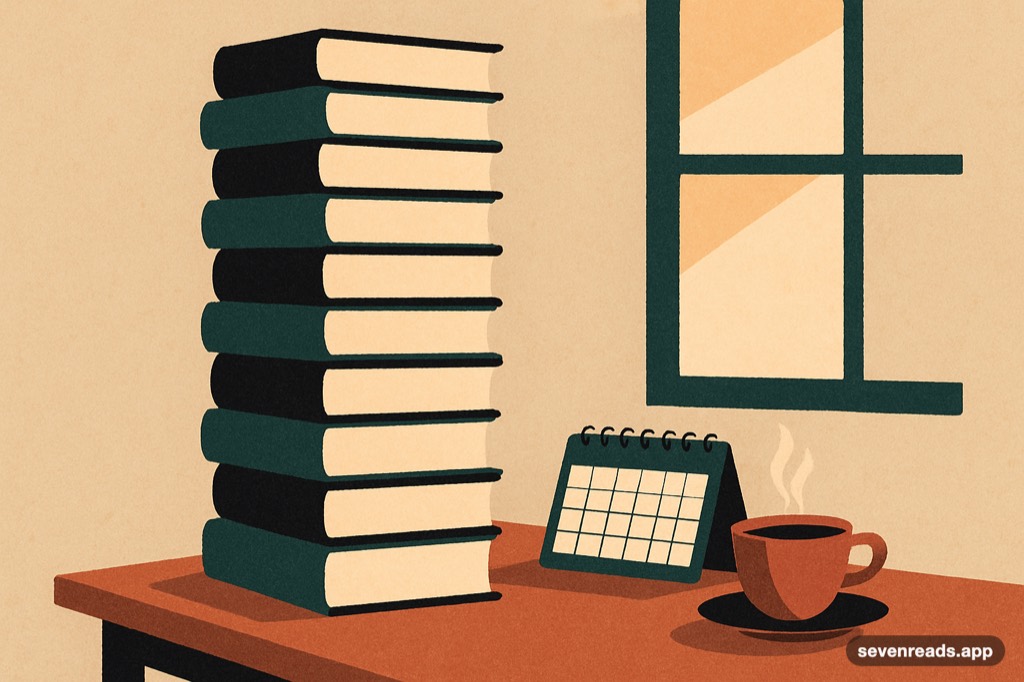
War and Peace takes most readers 32 to 38 hours of actual reading — call it 35. At a sustainable thirty minutes a day, that's ten weeks; at an hour, five; at weekend-warrior pace, a long winter. The number sounds like a verdict and works better as a plan: this is a book people fail by starting sprints and finish by scheduling walks.
Here's the honest math, the schedule that survives real life, and the two facts about the book that make the hours easier than they sound.
Seven Reads tracks your streak through all 35 hours — and untangles every Rostov on request.
Get Seven ReadsThe math, honestly
The novel runs roughly 560,000 words in English. At a typical adult pace of 250–300 words per minute for fiction, that's 31–37 hours of eyes-on-page time — before any re-reading of battle chapters or consulting of family trees. Round to 35 and plan against it. (For calibration: that's about four seasons of a prestige drama, a comparison that reframes the commitment for most people.)
The schedule that actually finishes it
Every completed War and Peace we know of was read on a streak, not a binge: a fixed daily slot of 20–60 minutes, protected like an appointment. The book's own structure supports this — its chapters are famously short, often three to five pages, so any slot ends at a natural break. The failure mode is the opposite plan: heroic weekend sessions with week-long gaps, which reset the name-memory each time and turn the cast into strangers. Daily contact, even brief, is the whole strategy — it's why streaks work on long books especially.
Why the hours read faster than they sound
Two facts flatter the total. First, Tolstoy is a page-turner in disguise: gossip, duels, proposals, battles — the chapters move like serialized fiction because they effectively were. Second, the difficulty is front-loaded: the opening salon scenes drop forty names in twenty pages, and readers who survive to the first battle report the book easing dramatically. Budget your patience for week one specifically, use grounded who-is-this questions freely there, and the remaining nine weeks are mostly pleasure.
If ten weeks is too many
Honest alternatives: Anna Karenina is two-thirds the length with none of the historical essays; the essays themselves can be read at skim-speed on a first pass (Tolstoy signposts them clearly) saving three or four hours; and there's no rule against a season per volume. The one dishonest alternative is the summary — this is a book whose value is structurally unsummarizable, because what it does, it does with accumulated time.
Frequently asked questions
How many hours does War and Peace take to read?
About 32–38 hours for most readers — roughly 560,000 words at typical fiction pace. At thirty minutes a day that's ten weeks; at an hour a day, five.
Is War and Peace hard to read?
The prose is famously clear — the difficulties are length, Russian naming conventions, and a name-dense first fifty pages. Short chapters and a daily schedule handle the length; grounded who-is-this questions handle the names.
Should I skip the historical essays?
Skimming them on a first read is a respectable tradition — read the first few to learn Tolstoy's argument against great-man history, then move at whatever speed protects your momentum. The story is self-sufficient without them.