AI Book Summaries vs. Actually Reading
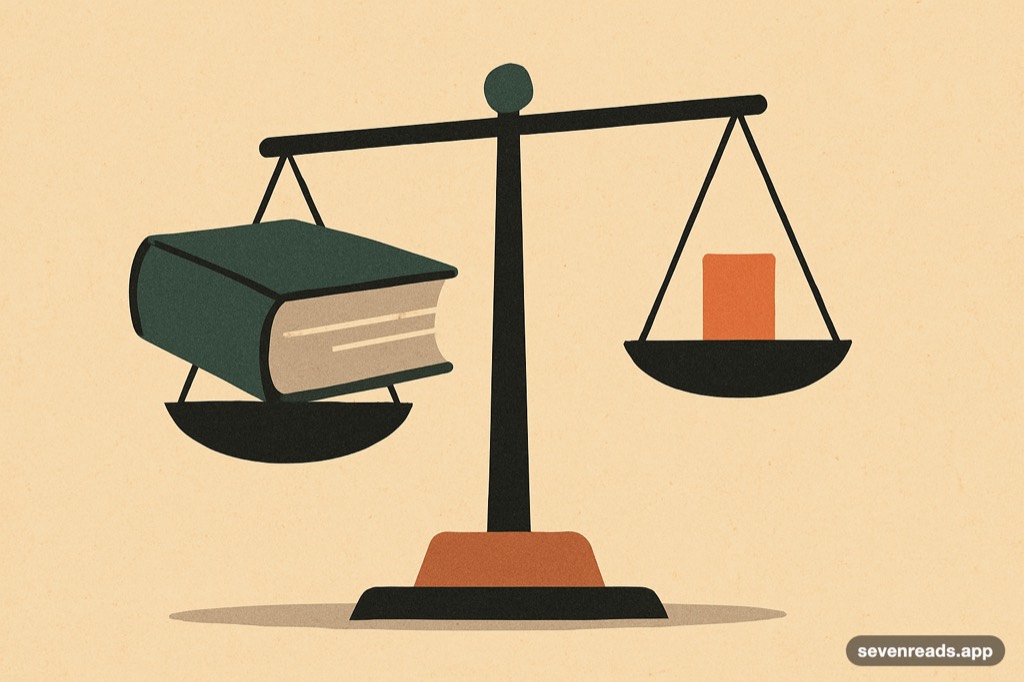
An AI summary gives you a book's conclusions. Reading gives you the argument, the evidence, the voice, and — the part nobody mentions — the hours of your own thinking that happen along the way. Both are legitimate tools. The mistake is believing they're the same product at different speeds.
We build reading software, so we have a horse in this race; we've tried to account for that by being specific about what summaries genuinely do well. Here's the honest ledger.
Seven Reads is built for the reading — with AI for the parts summaries can't do.
Get Seven ReadsWhat a summary actually gives you
Three real things. Triage: a summary tells you whether a book deserves your next twenty hours, which is worth a lot — most books don't. Reactivation: a summary of a book you have read revives it years later better than your own fading memory. And coverage: for books that are one idea padded to publishing length — a real genre — the summary honestly is the book.
Used this way, summaries are a filter in front of reading, not a substitute for it. The trouble starts when the filter becomes the diet.
What the summary silently drops
The argument. A summary keeps conclusions and discards the reasoning that earned them — but the reasoning is the transferable part. Knowing an author's five takeaways gives you sentences to repeat; following how they got there gives you a method you can run on problems the author never saw.
The encounter with difficulty. The sentences you have to reread, the chapter that rearranges the ones before it — that friction is the learning. Comprehension research keeps finding the same thing: memory forms in proportion to the processing you do, and summaries are engineered to remove exactly that processing. This is why summary-app readers report the same experience: everything sounds insightful, nothing sticks. There's no shortcut around doing the encoding yourself.
Your own reading. Two people read the same book and take different things from it, because each reads with their own questions. A summary is somebody else's reading — competent, generic, and never yours. The marginal note you'd have written, the objection you'd have raised, the connection to your own work: none of it exists, because you weren't there.
Fiction entirely. A plot summary of a novel relates to the novel the way a map of a city relates to living there. Nothing important survives the compression.
The false choice
The summary-versus-reading framing assumes your options are "twenty hours" or "two minutes." But the twenty hours was never the real problem — the real problem is the confusion, lost context and forgotten threads that make the twenty hours feel like forty and end with the book abandoned. AI is genuinely good at removing that: a companion that answers the question you have at the moment you have it, recaps a chapter on demand, and walks you through the passages that fight back. Used that way, AI doesn't replace the reading — it protects it. You keep the argument, the friction and the ownership, and lose only the getting-stuck.
So when should you use which?
Summaries: for triage before committing, for reviving books you've finished, and for one-idea books you only need the idea from. Reading, with help on tap: for anything you want to keep — the classics, the difficult books, the books in your field, and any book you'd be embarrassed to only pretend to know. If a book is worth your time at all, it's usually worth actually reading; the summary's job is telling you which ones those are.
Frequently asked questions
Do you remember anything from AI book summaries?
Briefly. Summaries strip out the cognitive processing that forms long-term memory, so their content fades in days — the well-documented gap between recognition ("that sounds familiar") and recall (being able to explain it a month later). They work better as refreshers on books you've actually read.
Are AI book summaries accurate?
Usually for the headline ideas, less reliably for details — a general model summarizes from training memory, which blends editions and commentary and occasionally invents specifics. Summaries generated from a book's actual text are more accurate, but the deeper losses in this piece apply even to a perfect summary.
Is it cheating to use AI while reading a book?
Using AI to skip the book gets you a summary's benefits and costs, as above. Using AI while reading — to resolve confusion, test arguments and recap chapters — is the same thing readers have always done with footnotes, study guides and smart friends, just faster. The book still gets read; the thinking is still yours.
Keep the reading. Lose the getting-stuck.
Seven Reads gives every book an AI companion for confusion, arguments and recaps — so the twenty hours feel like what they are, and everything you take stays yours.
Get Seven Reads