Does AI Make You a Lazier Reader?
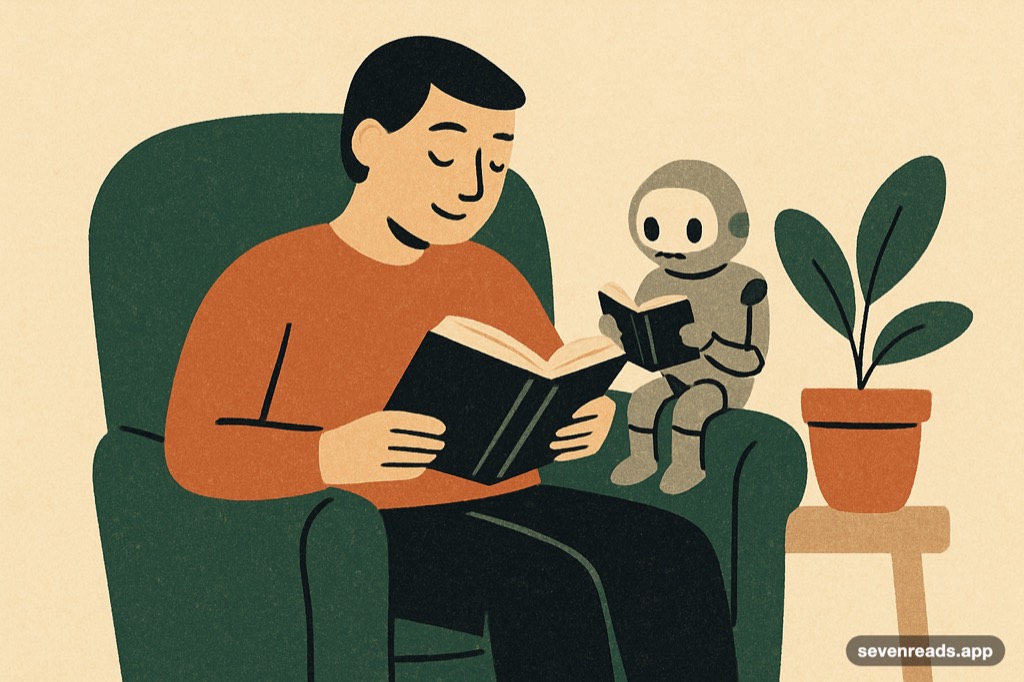
Yes, AI can make you a lazier reader — but not the way the worry is usually framed. The risk isn't that AI helps you too much; it's that a specific kind of help replaces the mental work that reading is for, while a different kind of help protects it. The line between the two is clean enough to state in one sentence: AI weakens reading when it does the thinking, and strengthens it when it keeps you thinking.
Here's where the line actually falls, what the research on offloaded effort says, and a simple test for any AI reading habit you're unsure about.
Seven Reads is AI on the effortful side of the line — it won't read the book for you.
Get Seven ReadsThe laziness that's real
Cognitive offloading is a real, well-studied effect: when a tool reliably does a mental task for us, the capacity quietly atrophies — the GPS effect, applied to comprehension. Reading has its own versions. If a summary substitutes for the book, the summarizing muscle — compressing an argument yourself — never fires; we've written a full accounting of that trade. Subtler: if you ask for an explanation at the first flicker of difficulty, you skip the productive struggle where comprehension actually forms. The reader who asks "what does this mean?" before rereading the sentence even once is outsourcing the exact effort that would have made them better at sentences like it.
So the critics aren't wrong that a failure mode exists. They're wrong about where it is.
The laziness that's imagined
The blanket version — real readers don't need help — has never been true of any era of reading. Readers have always leaned on footnotes, glossaries, study guides, marginal summaries in medieval manuscripts, and the smartest friend available. Nobody argues a dictionary makes you lazy. The test was never whether you used help; it's whether the help left the central work — following the argument, forming your own reading — in your hands.
And there's an empirical problem with the purist position: the alternative to "reading with help" is mostly not "reading heroically alone." It's not finishing. Books are abandoned at the point of sustained confusion — lost threads, forgotten characters, arguments that stopped making sense two chapters ago. A reader who quits a book exercises no reading muscles at all.
Where AI genuinely strengthens reading
Some uses of AI increase the thinking per page. Asking a companion to quiz you on a chapter is retrieval practice — the most evidence-backed memory technique there is. Asking "what's the weakest claim here?" and arguing with the answer is more critical engagement than most solo readers ever apply. Asking for the objection the author would least like to face forces you to hold the argument firmly enough to watch it be attacked. None of this is offloading; it's resistance training with a partner.
The recap deserves its own mention: catching up after two weeks away via a spoiler-free recap doesn't replace any thinking you'd otherwise have done — the realistic alternative was abandoning the book. Help that converts a dead book into a finished one is not laziness by any definition worth having.
The one-question test
For any AI reading habit: after the AI's answer, do you know something you can use, or have you just avoided a struggle you needed? Rough translations: reread the sentence once before asking; try your own chapter summary before requesting one; ask for objections, not verdicts. And prefer tools whose design pushes effort back at you — a companion that answers from the pages you've actually read and asks questions back is structurally on the right side of the line; a tool whose pitch is "never read the whole book again" is telling you which side it's on.
Frequently asked questions
Is using AI while reading considered cheating?
Cheating at what? If the goal is understanding, AI used for confusion-rescue, argument-testing and recall practice increases understanding per hour. If the "reading" is a summary standing in for the book, you've cheated only yourself out of the book's benefits — which is a choice, not a crime, but worth making with open eyes.
Does relying on AI explanations hurt reading comprehension?
It can if the explanation arrives before any effort — struggle-then-resolve is where comprehension grows. The fix is sequencing, not abstinence: reread once, form a guess, then ask. The explanation lands better on a prepared mind anyway.
What's a healthy way to use AI as a reader?
Ask questions at the moment of genuine stuckness, debrief at chapter ends (your summary first, then the AI's), argue with the book through the AI, and use recaps to rescue books after gaps. Avoid substituting summaries for books you actually care about.
Train with a partner, not a substitute.
Seven Reads answers from the pages you've read, argues back, quizzes you on demand — and never offers to read the book for you.
Get Seven Reads