Pandora's Box Meaning: It Was Never a Box
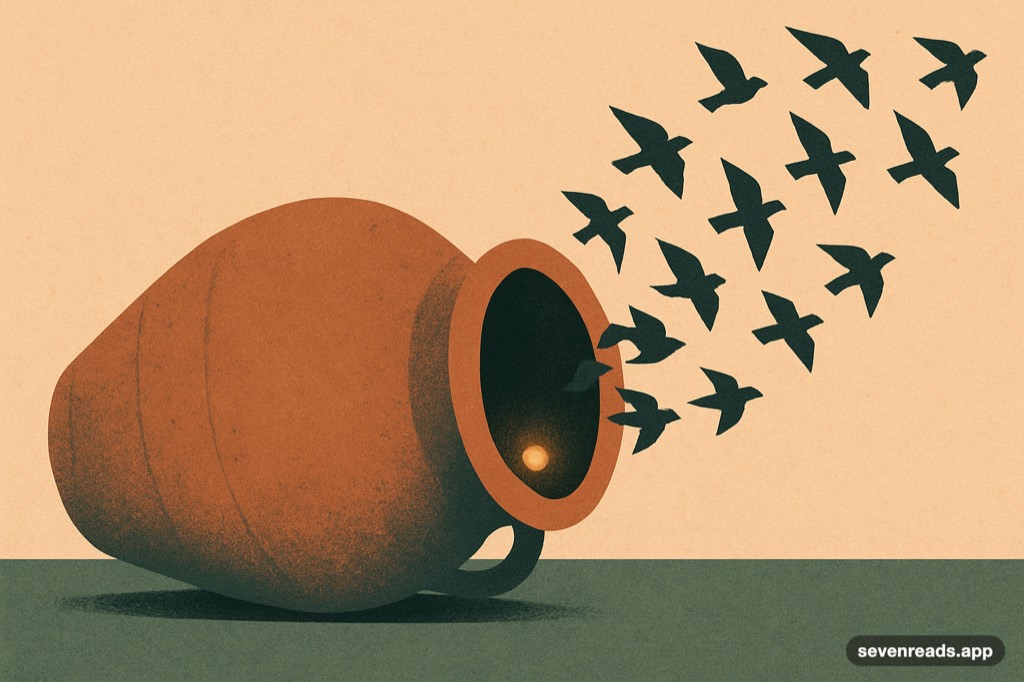
To open Pandora's box is to start something small that releases troubles you can never take back — the lawsuit that surfaces everything, the question that shouldn't have been asked. The idiom's cargo is irreversibility. The original, in Hesiod's poems from around 700 BC, differs from the postcard version in three famous ways: it was a jar, not a box (a mistranslation by Erasmus in the 1500s); Pandora herself — not just her container — was the trap, built to order; and after every evil escaped, one thing stayed inside: hope. What that means is the myth's oldest argument.
Here's the real story, the box that never was, and the riddle at the bottom of the jar.
Hesiod's originals are free in Seven Reads — start reading today.
Get Seven ReadsThe setup: revenge by gift
The jar is act two of a feud. Prometheus steals fire for humankind; Zeus, cheated, promises a counter-gift — "an evil in which they will all delight, embracing their own destruction." The gods build Pandora to specification: Hephaestus shapes her, Athena dresses her, Aphrodite pours on grace, Hermes installs "lies and wheedling words." Her name means "all-gifted" — every god contributed — and she is delivered to Prometheus's slower brother Epimetheus, whose name means Afterthought and who accepts, having been warned. The jar opens (Hesiod doesn't even dwell on the moment); sicknesses and sorrows scatter silently through the world; the lid claps down on hope alone. Like the Trojan horse, it's a Greek story about ruin arriving as a gift — but here the gift-wrap is a person, and the giver is heaven.
The box that never was
Hesiod's word is pithos — a man-height clay storage jar for grain, oil and wine, the ancient world's pantry. Erasmus, translating into Latin around 1508, apparently reached for pyxis, a small box or casket, and the mistake stuck because it improved the furniture: a box has a lid made for curiosity, a hinge made for one fatal moment. But the jar carries the better meaning — a pithos held a household's sustenance, so Hesiod's image is troubles stored where the food should be: the container of life's provisions, opened and found full of griefs.
The riddle of hope
Why does hope remain in the jar — kept for us, or from us? The comforting reading: whatever escapes, hope stays in humanity's keeping, the one resource the disaster left behind. The dark reading, which fits vengeful Zeus better: hope is one more evil — the deceiver that keeps mortals toiling — and it stayed inside because even that consolation was to be withheld, or because we're trapped with it. Nietzsche took the dark road: hope is "the most evil of evils, because it prolongs man's torments." The Greek word elpis means expectation, good or bad, which keeps the riddle honestly unsolvable — and twenty-seven centuries of readers have sorted themselves by which reading they can't help choosing.
Using the idiom
Precision: opening Pandora's box isn't just causing trouble — it's releasing a plurality of self-multiplying troubles via an act that cannot be undone, usually performed in curiosity or carelessness rather than malice. The discovery motion in litigation, the first reply-all, deciphering the archive. And the idiom quietly includes the last beat, whether users know it or not: something is always left at the bottom. What you call that something is your reading of the myth.
Frequently asked questions
What does opening Pandora's box mean?
Starting something irreversible that releases a cascade of troubles — usually through curiosity or carelessness. The idiom's core is that what escapes can never be recalled.
Was Pandora's box actually a box?
No — Hesiod wrote pithos, a large clay storage jar. The "box" comes from Erasmus's 16th-century Latin translation, and stuck because the image of a lid and a moment of curiosity was irresistible.
Why was hope left in Pandora's box?
The myth's oldest riddle. One reading: hope remains in our keeping — the consolation left behind. The other: hope is itself an evil, the deceiver that prolongs toil, withheld or trapped with us by design. Hesiod's word elpis (expectation) supports both.
Open the original yourself.
Hesiod's Works and Days is free in Seven Reads — start reading today.
Get Seven Reads