Trojan Horse Meaning: The Gift That Was a Weapon
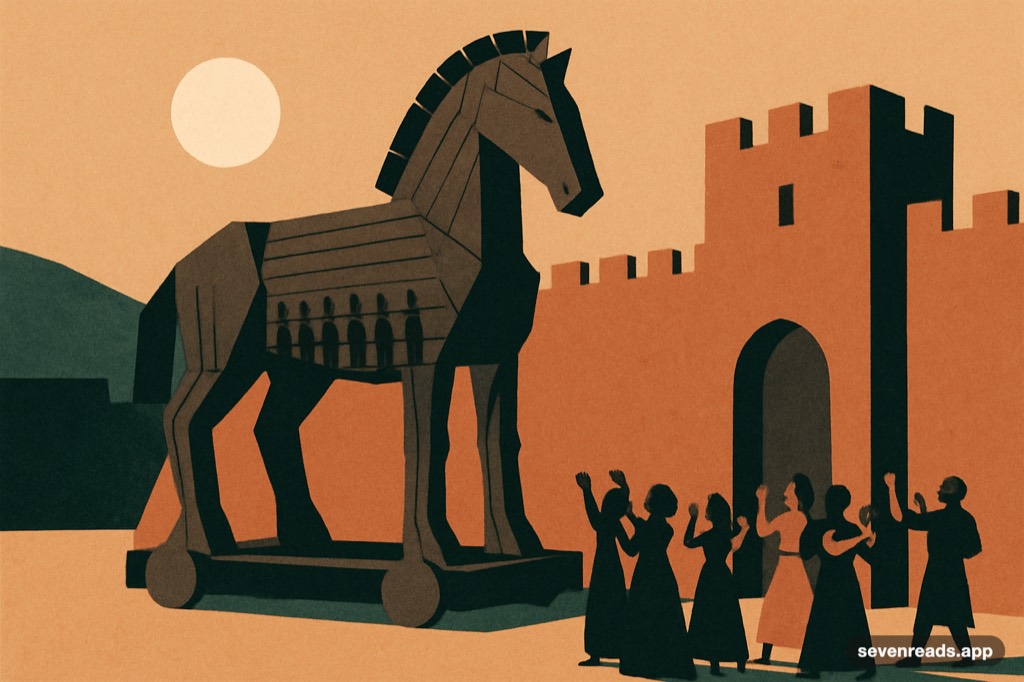
A Trojan horse is a threat that gets inside because the target carries it in — an attack disguised as a gift, a hire, an update, an alliance. The metaphor's power is in that last clause: the defenders' own hands do the work. The original is the wooden horse the Greeks left at the gates of Troy, hollow and full of soldiers, ending a ten-year siege in one night. And the famous first fact about the story: it isn't in the Iliad, which ends before the fall of Troy. The horse gallops in from elsewhere.
Here's the actual sources, the story's sharpest details, and what makes the metaphor precise rather than merely colorful.
The Odyssey is free in Seven Reads — start reading today.
Get Seven ReadsWhere the story actually lives
The Iliad closes with Hector's funeral, city still standing. The horse appears in the Odyssey — twice, as a story told about the war: a bard sings it at a banquet while Odysseus, its architect, weeps incognito in the audience; and Menelaus recalls Helen circling the horse, imitating the voices of the hidden men's wives to lure them into crying out. The full narrative — Sinon the false defector, the priest Laocoön hurling his spear into the planks and being strangled by sea serpents for it — comes down through Virgil's Aeneid, told by a survivor from the losing side. The tale's very transmission fits its theme: it arrives sideways, smuggled inside other stories.
The anatomy of the trick
Virgil's telling is a checklist of social engineering, twenty centuries early. The gift flatters its target (an offering to Athena, too sacred to leave outside). It comes with a storyteller — Sinon, whose tale of Greek betrayal makes the Trojans feel clever and merciful for taking him in. Warnings are neutralized by spectacle: Laocoön says the one true sentence in the episode — "I fear Greeks even bearing gifts" — and is immediately, publicly refuted by what looks like divine judgment. And the final door is opened by desire: after ten years, the Trojans want the war to be over, and the horse is shaped like that wish. Every modern con and computer "trojan" (the malware category is named directly from this) runs some subset of the same play — the payload rides inside the victim's own hope.
Using the metaphor precisely
Not every hidden danger qualifies. The specific mechanism: the target voluntarily brings the threat through its own defenses because of what the container appears to be. A bribed insider isn't a Trojan horse; a free app that harvests your contacts is. The acquisition that guts the acquirer, the beloved policy with a rider inside, the flattering job offer built to extract secrets — those are horses. The metaphor's warning, distilled: the gates you open are more dangerous than the walls' weak points, and the more welcome the gift, the better the search it deserves.
Read it in its home
The Odyssey's version costs an evening and comes with the strangest scene in epic: the trick's inventor listening to his own legend sung, and breaking down — the first recorded case of a man meeting his myth. Virgil's Book II is the blockbuster telling, an hour of sustained catastrophe, and the source of the line about Greeks and gifts.
Frequently asked questions
What does Trojan horse mean today?
Any threat disguised as something desirable, carried past defenses by the target's own choice — a deceptive gift, hire, deal or program. Trojan malware is named directly from the story.
Is the Trojan horse in the Iliad?
No — the Iliad ends with Troy still standing. The horse is recounted in the Odyssey as a tale told after the fact, and the full story comes from Book II of Virgil's Aeneid.
Who said beware of Greeks bearing gifts?
It's a paraphrase of the priest Laocoön in Virgil's Aeneid — "I fear the Greeks even bearing gifts" — spoken as he warned Troy against the horse, moments before serpents killed him and Troy took the omen the wrong way.
The original social engineering.
The Odyssey is free in Seven Reads — start reading today.
Get Seven Reads