Achilles' Heel: Meaning and Origin of the Phrase
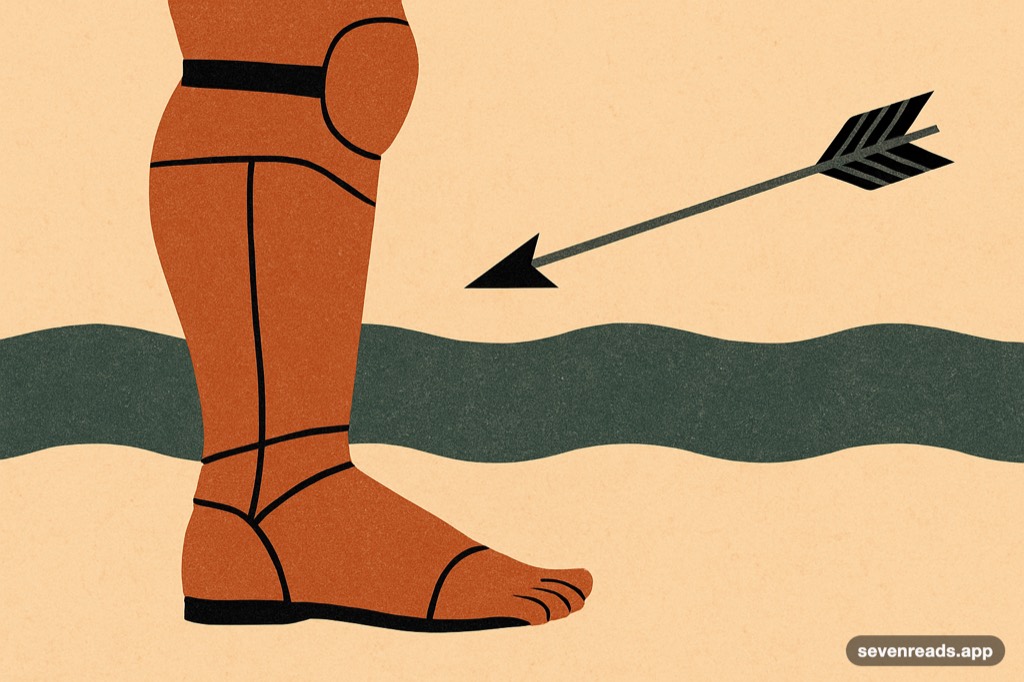
Everyone knows the story: Thetis dips baby Achilles in the River Styx to make him invulnerable, holds him by the heel, and years later an arrow finds the one spot she covered. Here's the surprise — none of that is in the Iliad. Homer's Achilles is not invulnerable, his death happens outside the poem entirely, and the Styx story appears in surviving literature only centuries later. The phrase "Achilles' heel" rests on the version of the legend Homer chose not to tell — and his choice is the more interesting story.
Here's where each piece actually comes from.
The Iliad is free in Seven Reads — start reading today.
Get Seven ReadsWhat Homer actually wrote
In the Iliad, Achilles bleeds. He knows a prophecy — stay and die young with glory, or go home and live long unknown — and his greatness is that he chooses while knowing. The poem ends before his death; the arrow, Paris, and Apollo's guidance are foretold within it but never shown. An Achilles who can only be harmed in one spot would wreck the poem's engine: his courage means something because every battle could kill him. Homer's hero is mortal everywhere, and that is the point of the whole poem.
Where the heel story comes from
The invulnerability legend grew in the centuries after Homer. The fullest surviving version of the Styx dip is remarkably late — the Roman poet Statius, first century AD, nearly a millennium after Homer. Earlier fragments and vase paintings show pieces of the tradition: the epic cycle's lost poems told of Achilles' death by Paris's arrow, and art sometimes shows it striking low. An older variant has Thetis burning away the baby's mortality by fire, interrupted at the ankle. The heel, in other words, is real mythology — but it's the aftermarket Achilles, not Homer's.
Why the phrase won anyway
"Achilles' heel" entered English in the nineteenth century and stuck because the image is perfect: total strength, one hidden flaw, and the flaw is where the finishing blow lands. It's the personal-scale version of what the Greeks called hubris at the moral scale — the exception that undoes the exceptional. The anatomical Achilles tendon, named in the seventeenth century, fixed the legend into every human body; the metaphor now outruns its source so completely that readers open the Iliad expecting a story it deliberately doesn't contain.
Read the version that's better
The real payoff of knowing the origin: Homer's Achilles is a deeper character than the legend's. A hero with one weak spot has a plot problem; a hero who knows he will die and chooses meaning anyway has the human problem. The Iliad runs about 12 hours, and its final scene — Achilles and the father of the man he killed, weeping together — is the moment the phrase never prepares anyone for.
Frequently asked questions
Is the Achilles heel story in the Iliad?
No — the Iliad's Achilles is mortal everywhere, and his death isn't shown in the poem. The Styx-dip story survives fully only in Statius, a Roman poet writing nearly a millennium after Homer.
How does Achilles die in Greek mythology?
An arrow from Paris, guided by Apollo — foretold within the Iliad but occurring after it ends. Later tradition places the wound at the heel; Homer never specifies an invulnerable body.
What does Achilles heel mean today?
A single fatal weakness in something otherwise strong. The phrase entered English in the nineteenth century, long after the legend it summarizes had displaced Homer's own version.
The hero without the loophole.
The Iliad is free in Seven Reads — start reading today.
Get Seven Reads