Juxtaposition Meaning: Meaning Made by Placement
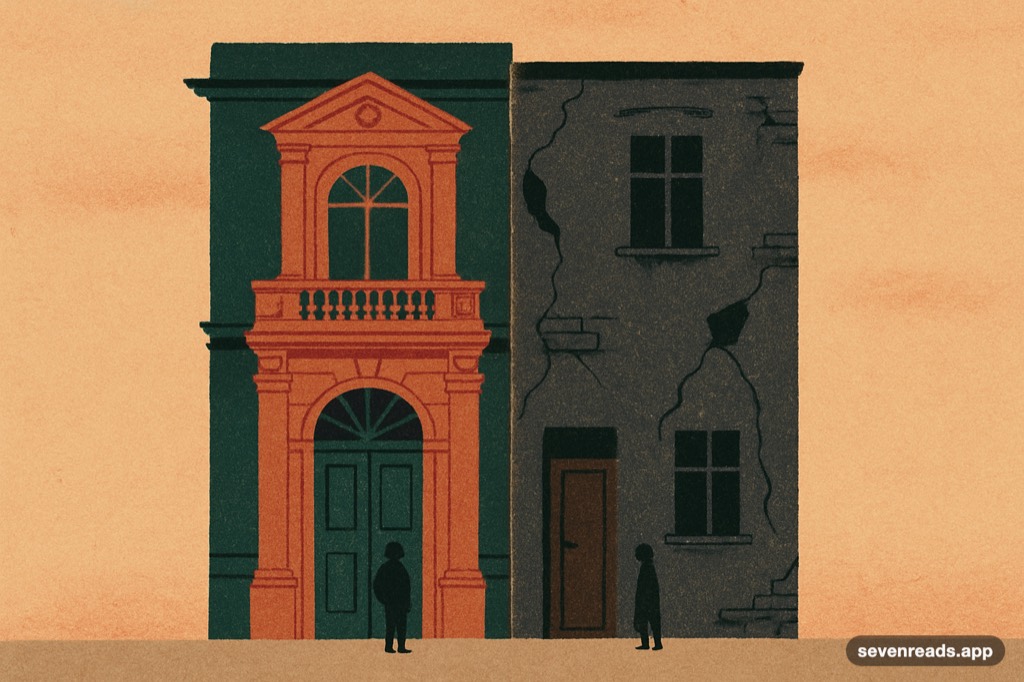
Juxtaposition is placement as argument: setting two things side by side — images, characters, sentences, scenes — so the contrast between them does work no commentary could. The word is just Latin for "placed next to" (juxta + positio), and the device's power is its silence: the writer arranges; the reader concludes; and conclusions readers draw themselves arrive pre-believed. It is the load-bearing technique of photography, film editing, poetry — and one novel opening so famous it functions as the device's own definition.
Here's how placement generates meaning, the classic demonstrations, and how to analyze it without just pointing.
The contrast classics are free in Seven Reads — start reading today.
Get Seven ReadsThe mechanism: the mind completes the circuit
Put two images adjacent and the mind involuntarily wires them: film theorists proved it with the Kuleshov effect — the same neutral face, intercut with soup, a coffin, a child, was read by audiences as hunger, grief, tenderness. Nothing was in the face; everything was in the adjacency. That's juxtaposition's whole engine: proximity implies relation, and the reader manufactures the relation unprompted. It's why the device is fundamentally an editing art — the meaning lives in neither element but in the cut between them — and why it beats commentary: stated contrast can be argued with; experienced contrast has already happened to you.
The famous demonstration
Dickens's opening is the device at maximum density: "It was the best of times, it was the worst of times, it was the age of wisdom, it was the age of foolishness…" — fourteen juxtaposed absolutes with not one word of adjudication, teaching the reader in a single paragraph how to read a novel (and an era — the title itself is a juxtaposition) built on doubled cities, doubled men, and a doubling that pays the plot's whole debt at the end. Tolstoy's title makes the same move at one-word scale, and his method scales it up: ballroom chapter against battlefield chapter, no bridge, the reader left to feel what the adjacency asserts.
The device across the arts
Poetry compresses it: Pound's two-line "In a Station of the Metro" is one juxtaposition ("faces in the crowd" / "petals on a wet, black bough") presented without even a verb. Photography stakes careers on it — the wedding party passing the funeral, the billboard's paradise above the breadline. Montage is its cinematic industrialization. And argument uses it as the honest sibling of insinuation: the investigative piece that places the executive's bonus figure beside the layoff count, and adds nothing. In every medium the grammar is identical — A, B, silence — and the silence is where the meaning detonates.
Analyzing it properly
The weak move in essays is spotting it ("the author juxtaposes X and Y") and stopping — placement isn't yet meaning. The strong move names what the adjacency generates: what third thing exists in the gap that neither element contains alone (the Metro poem's gap holds transience; Dickens's holds the whole revolutionary question of whether any verdict on an age is possible). Test for load-bearing juxtaposition: swap or separate the elements and see what dies. If nothing, it was decor; if the meaning collapses, you've found where the work actually lives.
Frequently asked questions
What does juxtaposition mean with examples?
Placing two things side by side so their contrast makes the point silently — Dickens's "best of times, worst of times," a wedding photographed beside a funeral. The meaning lives in the gap between the paired elements.
What is the most famous example of juxtaposition in literature?
The opening of A Tale of Two Cities — fourteen juxtaposed absolutes with no adjudication — and Tolstoy's War and Peace, which performs the device in its title and structures the novel by it.
How do you analyze juxtaposition in an essay?
Name the third thing the adjacency generates that neither element contains alone — then test it: separate the pair and see what meaning dies. Merely spotting the device isn't yet analysis.
The meaning lives in the gap.
Dickens and Tolstoy are free in Seven Reads — start reading today.
Get Seven Reads