A Tale of Two Cities AI: a reading companion that never spoils it
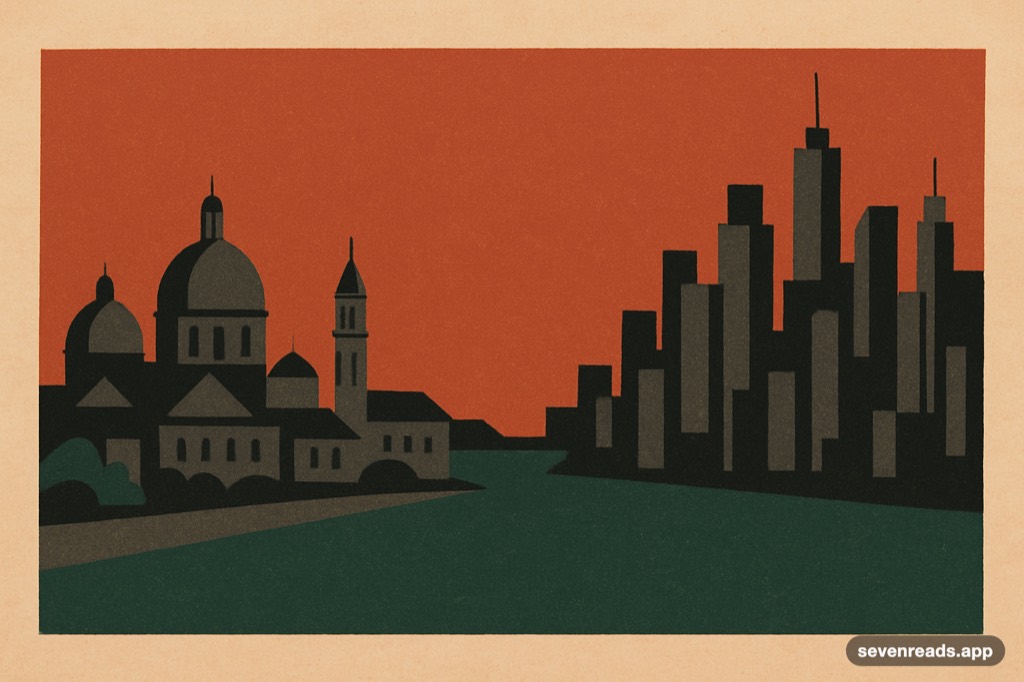
Reading A Tale of Two Cities with an AI companion means you can ask questions about the book — by typing or by voice — and get answers grounded in the pages you've actually read, never the ones ahead. Dickens's leanest novel — no subplot sprawl, one machine of a story about two men with the same face and a revolution that grinds toward one household. The famous first and last lines get quoted everywhere; the plotting between them is the actual marvel.
A Tale of Two Cities is free in Seven Reads — start reading today.
Get Seven ReadsWhat readers actually ask about A Tale of Two Cities
These are the kinds of questions a companion earns its keep on — asked mid-page, answered from the text you've read, without judgment and without leaks:
“Why does the book open with all those paradoxes?”
The best-of-times opening isn't throat-clearing — it announces the novel's method, which is doubling: two cities, two men, two trials, resurrection against slaughter. Nearly everything in the book has a twin; noticing the pairs is half the reading.
“What does "recalled to life" mean?”
It's the book's first mystery — a message about a man "recalled to life" — and its master metaphor: prisoners, secrets and reputations keep being dug up and revived. Watch how many characters get some form of resurrection; the theme pays off in the ending.
“Are the revolutionaries the villains?”
Dickens refuses the easy version: the novel is unsparing about aristocratic cruelty first, then unsparing about the Terror that answers it. The knitting women are among his most frightening creations precisely because the book makes you understand them before it makes you fear them.
The spoiler problem with A Tale of Two Cities
The novel runs on resemblance, recalled prisoners and a debt called in at the worst hour; its climax is engineered so that a dozen planted details fire at once. The last chapters are so famous that stray quotation can spoil them — treat even the closing line as a plot point. A general chatbot has read the whole book and will eventually let that knowledge shape an answer. Seven Reads' companion is position-aware: it retrieves only from text before your bookmark, so it cannot reveal what you haven't reached — ask about the ending early and it declines, and tells you where you are instead.
How to read A Tale of Two Cities with Seven Reads
Add the book from the built-in store — it's one of 50,000+ public-domain classics included free — and just start reading. Highlight what strikes you, add notes when the thought arrives, and ask the companion anything the moment you wonder. When you finish, Seven writes two things: the book's overview, and a synthesis of what you noticed, built from your own notes and questions. If it's your first classic in a while, our guide to starting the classics pairs well with this book.
Frequently asked questions
Can I read A Tale of Two Cities for free?
Yes. A Tale of Two Cities is in the public domain, and a well-formatted copy is included free in Seven Reads — one tap adds it to your library, where it reads like any other book, with your position, highlights and notes kept.
Can AI discuss A Tale of Two Cities without spoiling it?
Only if the AI is position-aware. Seven Reads tracks exactly where you are in A Tale of Two Cities and answers only from the pages behind your bookmark — everything ahead is structurally excluded, so asking about the ending gets a refusal, not a leak. The final movement is a plan executed under a guillotine's clock — the least skippable ending he wrote.
How long does it take to read A Tale of Two Cities?
Around 9 hours for most readers. At twenty minutes a day, that's roughly 4 weeks — and a streak matters more than any single sitting.
More classics to read with AI
- All 77 classics you can read with AI — the full list
- Great Expectations AI — Charles Dickens
- Les Misérables AI — Victor Hugo
- The Scarlet Letter AI — Nathaniel Hawthorne
- How the no-spoilers guarantee works