Hamartia Meaning: The "Tragic Flaw" That Isn't a Flaw
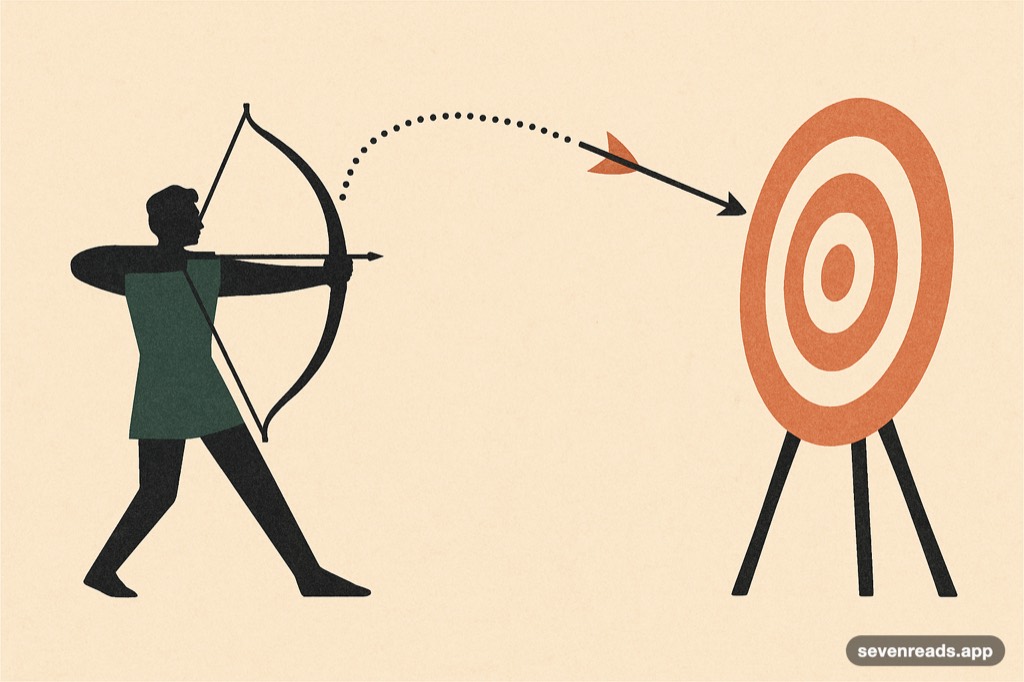
Hamartia (hah-mar-TEE-ah) is the term from Aristotle's Poetics that English learned as "tragic flaw" — and the translation has misled generations of essay-writers. The Greek word is an archery term: it means missing the mark, an error, a mistake — not a defect of character. Aristotle's claim was that the best tragic hero falls "not through vice or depravity, but through some hamartia": some miscalculation or ignorance, made by a person good enough that we shudder at the fall. The difference between a flaw and a mistake turns out to be the difference between two whole theories of tragedy.
Here's what Aristotle actually said, why "flaw" caught on anyway, and how the two readings change every play they touch.
The Poetics is free in Seven Reads — start reading today.
Get Seven ReadsThe archer's word
In classical Greek, hamartanein is what an archer does when the arrow misses: the aim was taken, the shot was real, the mark was not hit. Applied to action, it covers the family of going-wrong-without-being-bad: acting in ignorance of a crucial fact, misjudging a situation, choosing reasonably on false information. (New Testament Greek later took the same word for "sin" — every sin a missed mark — which is its own sermon.) Aristotle's requirement in the Poetics is structural: the hero must be neither villain (whose fall pleases us) nor saint (whose fall merely disgusts us), but a good person whose error — not wickedness — releases the catastrophe. Pity needs undeserved suffering; fear needs "that could be me." Mistakes supply both. Vices supply neither.
Exhibit A: Oedipus
Aristotle's model tragedy makes the case cleanly. Oedipus's catastrophe flows from ignorance — he doesn't know his parentage, kills a stranger at a crossroads, marries a widowed queen — every step reasonable on the facts he has. Hunt for a character flaw and you get the usual suspects (temper, pride in his own cleverness), but notice: none of them causes the horror; the horror was complete before the play begins, waiting to be discovered. His hamartia is a missed mark in the oldest sense — he aimed at escaping the prophecy and his very aim carried him into it. The "flaw" reading turns the play into a morality lesson; the "error" reading keeps what makes it terrifying — that goodness is no protection against ignorance. (Freud's famous rereading required ignoring exactly this.)
Why "flaw" won anyway
Partly moralism — audiences prefer a universe where the fallen earned it, and "flaw" restores the justice "error" removes. Partly Shakespeare: his tragedies genuinely do run on character — Macbeth's ambition, Othello's jealousy, Lear's vanity are causes, not mistakes — so the Renaissance re-tuned Aristotle's term to fit the plays in front of it. The honest position is that both models exist: error-tragedy (Sophocles) where catastrophe outruns desert, and character-tragedy (Shakespeare) where the self is the trap. Knowing the word's real meaning lets you ask the sharp question of any tragedy: did this person fall through what they did, or through what they were?
Using the term
In essays and criticism, "hamartia" earns its keep when you specify which kind: Oedipus's is ignorance, Romeo's is haste, Macbeth's is genuinely a flaw operating as one. And the concept travels beyond drama — post-mortems of disasters regularly find hamartia rather than villainy: the reasonable decision on wrong information, the aim that carried the archer into the target. That's Aristotle's enduring point: the scariest failures don't require bad people.
Frequently asked questions
What does hamartia actually mean?
Missing the mark — an archery term for error, not "flaw." Aristotle's tragic hero falls through a mistake or crucial ignorance, not through vice; the mistranslation "tragic flaw" moralized the concept.
What is Oedipus's hamartia?
Ignorance of his parentage — every disastrous act follows reasonably from facts he doesn't have. His temper and pride color the play, but the catastrophe is caused by the missed mark, not a character defect.
Is hamartia the same as a tragic flaw?
Not originally. "Tragic flaw" fits Shakespeare, where character causes the fall (Macbeth's ambition). Aristotle's hamartia fits Sophocles, where error does. Both models are real; the terms name different tragic engines.
The word that splits tragedy in two.
The Poetics is free in Seven Reads — start reading today.
Get Seven Reads