Et Tu Brute Meaning: Caesar's Last Words, Fact-Checked
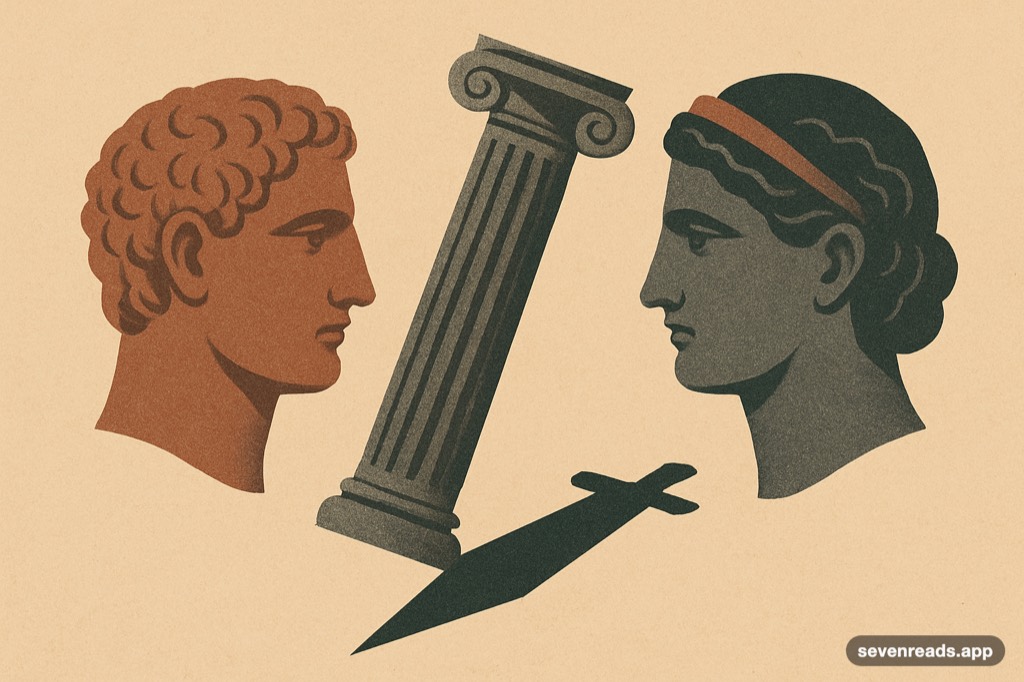
"Et tu, Brute?" is Latin for "You too, Brutus?" — the words Shakespeare's Julius Caesar speaks as he recognizes his friend among the assassins, before adding "Then fall, Caesar," and dying. The phrase now means the moment of ultimate betrayal: the wound that matters not for the blade but for whose hand holds it. The historical footnote makes it better, not worse — the real Caesar almost certainly never said it, and the last words the ancient sources do report are stranger and sadder than Shakespeare's Latin.
Here's what the phrase means, what the sources say, and why the fiction beat the history.
Shakespeare and the Roman sources are free in Seven Reads — start reading today.
Get Seven ReadsWhat the sources actually report
Suetonius, writing about 150 years after the Ides of March, 44 BC, says Caesar died "without a word" — but records a rumor: that as Marcus Brutus struck, Caesar said, in Greek, kai su, teknon — "you too, child?" (or "even you, my son?"). Plutarch says only that when Caesar saw Brutus's dagger he pulled his toga over his head and stopped resisting — surrender as the last gesture. The Greek phrase is a genuine puzzle: tender ("my child"), or possibly a known curse formula ("you too will get yours") — scholars still argue whether the dying Caesar was grieving or threatening. Shakespeare compressed rumor, Greek and ambiguity into three clean Latin words, and history lost the copyright.
Why the line lands
The construction does the work. Et tu — "even you" — carries an entire relationship in two syllables: everything Brutus was to Caesar (protégé, near-son, forgiven former enemy) is invoked and cancelled at once. And "Then fall, Caesar" makes the death voluntary: the wound that kills him is the recognition, not the knife. Shakespeare's crowd scene then runs the knife twice — Antony's funeral oration calls Brutus's cut "the most unkindest cut of all," teaching the audience explicitly that betrayal is measured by intimacy. The play is, among other things, a treatise on why the closest hand cuts deepest.
Brutus's side of the blade
The phrase's afterlife flattens Brutus into a traitor, but both Plutarch and Shakespeare are fairer. Plutarch's Brutus — the ancestor-haunted republican who joins the conspiracy to prevent a king — was Shakespeare's direct source, and the play keeps his agony intact: "not that I loved Caesar less, but that I loved Rome more." Dante, taking the other view to its limit, put Brutus in the lowest circle of Hell, chewed eternally beside Judas in the Divine Comedy — betrayal of a benefactor as the worst sin possible. Seven centuries of readers have used the same three words to argue both verdicts, which is what a perfect phrase is for.
Where to read it
Shakespeare's Julius Caesar takes about three hours, and Act III — murder, funeral, riot — is as good as the stage gets; Plutarch's lives of Caesar and Brutus supply the source material and read like a novelist's notebook. The Rubicon and veni vidi vici complete Caesar's three-phrase biography: the gamble, the boast, and the bill.
Frequently asked questions
What does et tu Brute literally mean?
"You too, Brutus?" in Latin — Shakespeare's version of Caesar's dying recognition that his friend was among the assassins. It now names any betrayal by someone close.
Did Caesar really say et tu Brute?
Almost certainly not. Suetonius says he died silently, while recording a rumor that he said in Greek "kai su, teknon" — "you too, child?" The clean Latin line is Shakespeare's invention from 1599.
Why did Brutus betray Caesar?
By his own account, to save the Republic from a king: "not that I loved Caesar less, but that I loved Rome more," in Shakespeare's version. Whether that makes him patriot or traitor has been argued for two thousand years — Dante put him in Hell's lowest circle for it.
Three hours for the Ides.
Julius Caesar and Plutarch are free in Seven Reads — start reading today.
Get Seven Reads