Crossing the Rubicon Meaning: The Point of No Return
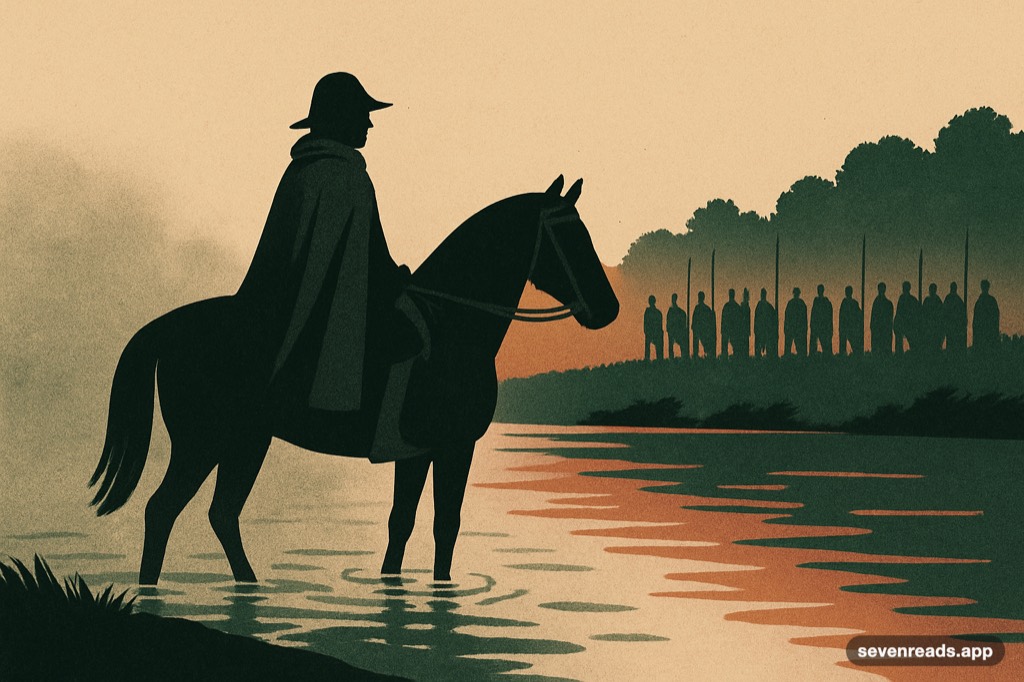
To cross the Rubicon means to take an irrevocable step — to commit to a course from which there is no going back. The Rubicon was a real and unimpressive river in northern Italy, and its fame is entirely legal: it marked the boundary of Italy proper, which a Roman general was forbidden to cross with his army. When Julius Caesar led the 13th Legion over it in January 49 BC, he wasn't fording a stream; he was declaring civil war — and he knew it, which is what the phrase has meant ever since.
Here's the law that made a creek historic, the scene the ancient writers describe, and the phrase's exact modern grammar.
Plutarch and Suetonius are free in Seven Reads — start reading today.
Get Seven ReadsWhy a small river was a tripwire
Rome's deepest political fear was its own generals. Provincial commanders held armies; the city held none; so law drew a line — a general entering Italy under arms committed treason, automatically. The Rubicon was simply where that line crossed the map on the Adriatic side. In 49 BC the Senate, maneuvered by Caesar's rivals, ordered him to disband his legions and return as a private citizen — to walk into prosecution disarmed. His choice was exquisitely binary: obey and be destroyed by law, or cross and make the law itself the battlefield. The genius of the phrase is that the river did nothing; the meaning was entirely in the crossing.
"The die is cast"
The ancient accounts give the moment its second famous phrase. Plutarch and Suetonius describe Caesar pausing at the bank — Suetonius adds an omen, a supernatural figure with a trumpet — weighing, in Plutarch's words, "how great the evils to all mankind" that would follow. Then he said alea iacta est — "the die is cast" — and crossed. (Plutarch says he said it in Greek, quoting a line from comedy: "let the die be thrown" — a gambler's phrase, tossed off as a joke at the largest stake in the world.) The two idioms are one thought in two tenses: crossing the Rubicon is the act; the die is cast is what's true one second after.
What happened next
Everything the pause foresaw: five years of civil war across three continents, the Republic's effective end, dictatorship, and the Ides of March — Brutus's dagger being, in a sense, the Rubicon's bill arriving. The irony historians savor: the men who forced the choice believed they were saving the Republic, and their ultimatum destroyed it. The phrase carries that shadow too — a Rubicon is often a line someone else drew, badly.
Using the phrase precisely
A true Rubicon needs two features: irrevocability (the option to retreat ends at the line) and knowledge (the crosser understands this at the time). Quitting the stable job to found the company, publishing the accusation, the first drink after ten years dry — crossings. A decision that merely turned out badly, or whose weight was invisible until later, is not one; the phrase's whole cargo is the open-eyed pause at the bank. That pause — Caesar reckoning the evils, then throwing the dice anyway — is what you invoke every time you say it.
Frequently asked questions
What does crossing the Rubicon mean?
Taking an irrevocable step, knowingly — from Caesar leading his army across the Rubicon river in 49 BC, which by Roman law was an automatic declaration of civil war.
What did Caesar say when he crossed the Rubicon?
"Alea iacta est" — the die is cast. Plutarch says he spoke it in Greek, quoting a comic playwright: a gambler's phrase thrown at the largest stake imaginable.
Where is the Rubicon river?
In northeastern Italy, flowing into the Adriatic near Rimini — a modest stream whose only significance was legal: it marked the border no returning general could cross under arms.
Stand at the bank with him.
Plutarch's Caesar is free in Seven Reads — start reading today.
Get Seven Reads