Dharma and Karma: Meaning in the Bhagavad Gita
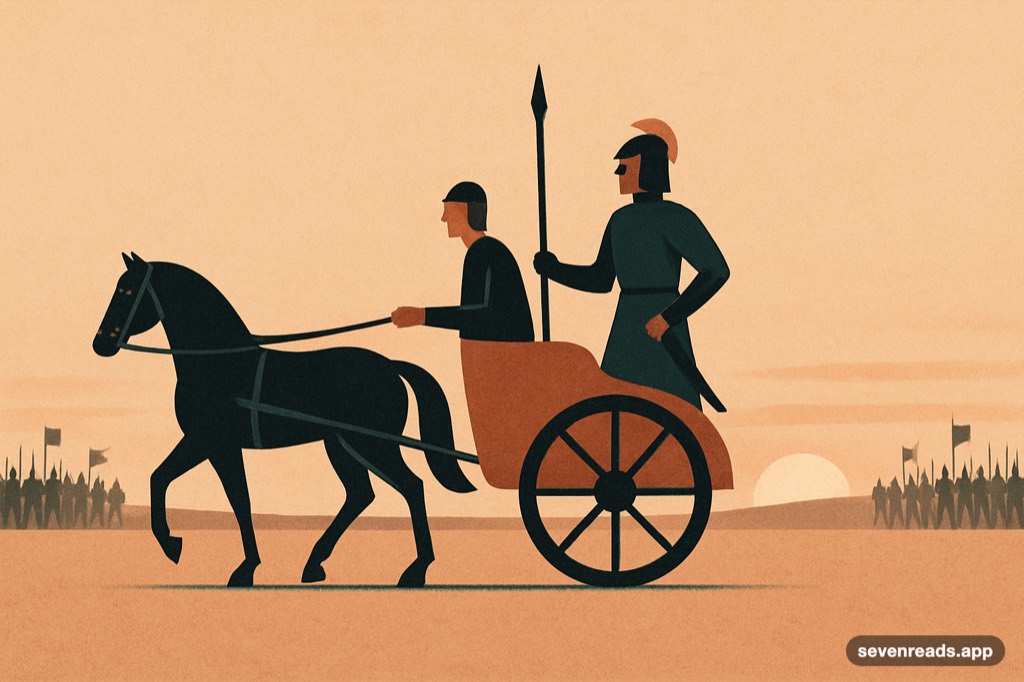
The Bhagavad Gita opens with the strongest objection its own teaching will face: the warrior Arjuna, seeing family and teachers in the opposing army, drops his bow — better to renounce than to act terribly. The seven hundred verses that follow are Krishna's answer, built on two load-bearing concepts: dharma, the duty belonging to your position and nature, and karma, the law by which actions bear consequences — culminating in the Gita's signature move: act fully, and renounce not action but attachment to its results.
Here's what the two terms actually mean, and how the Gita's argument assembles them.
The Gita is free in Seven Reads — start reading today.
Get Seven ReadsDharma: duty with a metaphysics
Dharma resists one-word translation — duty, law, order and nature all catch parts. In the Gita's usage it's the action that belongs to you: partly by role (Arjuna is a warrior; his dharma includes fighting just wars), partly by situation, partly by your own nature (svadharma — the text insists your own duty done imperfectly beats another's done well). The concept assumes a morally ordered cosmos where positions carry obligations — which is both its power (duty isn't preference; it's structure) and the site of its hardest modern questions, since the role-assignments of its era included caste. Reading the Gita well means holding both: the depth of duty-as-structure, and the live argument about who assigns the roles.
Karma: the physics of action
Karma in the Gita is not fate, luck or cosmic points — it's the claim that actions have consequences that bind the actor: every act plants seeds that fruit in character, circumstance and (in the text's framework) future births. The bind is the problem: even good actions, done for their fruits, chain you to the wheel of consequence — desire for results corrupts action at the root, producing anxiety before, distortion during, and bondage after. Renouncing action entirely (Arjuna's first instinct) fails too: the text is blunt that inaction is impossible — even sitting still is a choice with consequences. The trap looks total, which is exactly where the Gita's innovation enters.
Karma yoga: the untying move
Krishna's central teaching — karma yoga, the discipline of action — cuts between the horns: act according to dharma, with full skill and commitment, while renouncing attachment to the fruits. You have a right to the action, the famous verse teaches, never to its results. This isn't indifference to outcomes (the archer still aims) but non-possession of them: doing the work because it's yours to do, with the anxiety-economy of success and failure dissolved. The psychological claim is testable in any modern arena — performance under detachment from results is what athletes call being in the process — and the spiritual claim goes further: action so performed stops binding, becoming, when offered rather than owned, a path to liberation equal to meditation or devotion.
Why the battlefield matters
The setting is the argument: the Gita refuses to teach detachment from a mountaintop — it teaches it at the exact point where duty is most terrible, to a man who must act now. That's why Thoreau carried it, why Gandhi called it his dictionary of daily reference while reading it as an allegory of the inner battle, and why the debate over its literal-versus-allegorical war remains permanently productive. It's also why the book rewards slow reading with pushback: every chapter assumes you're Arjuna, and the objections you raise are the ones Krishna answers next.
Frequently asked questions
What does dharma mean in the Bhagavad Gita?
The duty belonging to your position, situation and nature — action as obligation within a morally ordered cosmos. The Gita stresses svadharma: your own duty, even done imperfectly, over another's done well.
What does the Gita teach about karma?
That action inevitably bears binding consequences — and that attachment to results, not action itself, is what binds. Its solution, karma yoga: act fully according to duty while renouncing ownership of outcomes.
Do I need to be religious to read the Bhagavad Gita?
No — it's read worldwide as philosophy and psychology of action: duty, detachment and performance under pressure. The theological framework is there for readers who want it; the argument stands for those who don't.