Wu Wei Meaning: Doing by Not Doing
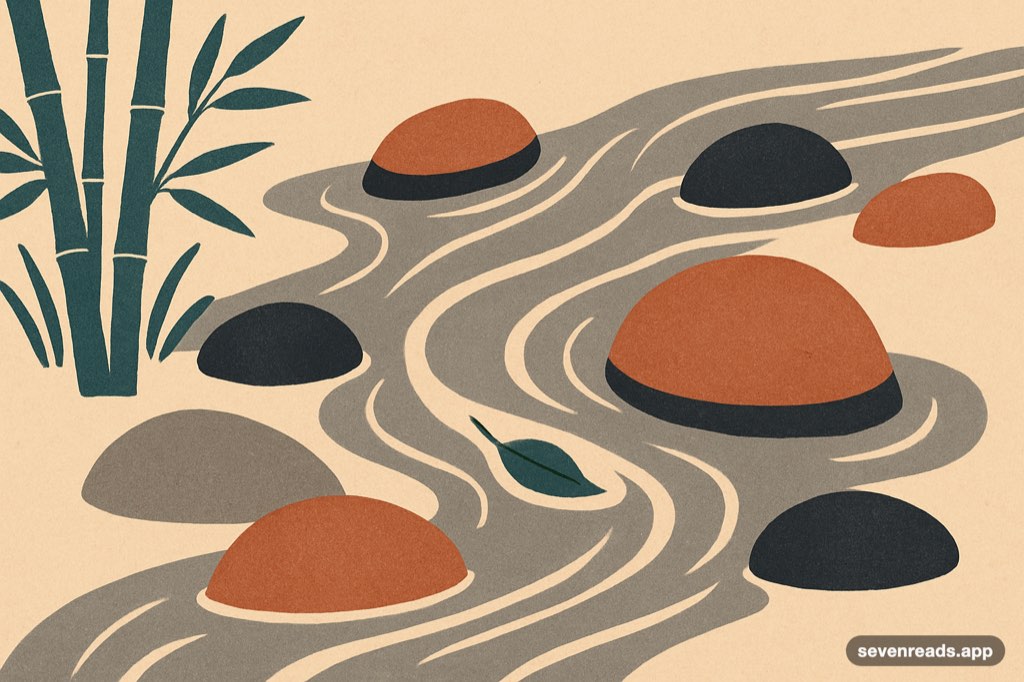
Wu wei is the Taoist ideal usually translated "non-action" and better understood as unforced action: effectiveness that works with the grain of situations rather than against it, the way water defeats stone without ever striking it. It's the central practical teaching of the Tao Te Ching, and the most mistranslated idea in Eastern philosophy — because "doing nothing" is exactly what it doesn't mean.
Here's what the concept actually teaches, the water logic behind it, and where a modern reader can watch it work.
The Tao Te Ching is free in Seven Reads — start reading today.
Get Seven ReadsNot "no action" — no forcing
The Tao Te Ching's paradoxical formula is that the sage does nothing, yet nothing is left undone. The resolution of the paradox is in what counts as "doing": wu wei opposes contrived action — forcing, straining, imposing your plan against the situation's nature — not activity itself. The skilled version of anything demonstrates it: the expert whose cuts follow the material's own seams, the sailor who uses the wind she cannot command, the conversation that persuades because it stopped pushing. Effort is still present; friction isn't. What's been removed is the fight with reality.
The water argument
The book's master image: water is the softest thing, yet it overcomes the hardest; it seeks the low places everyone despises, yet benefits all things; it never contends, yet nothing outlasts it. This isn't decoration — it's a competitive claim: yielding beats rigidity over time, adaptability beats strength, and position (the low place, where everything flows to you) beats assertion. The Tao Te Ching applies it to rulers ("govern a great state as you would cook a small fish" — minimal poking), to conflict, and to self-cultivation. Two millennia later, judo and aikido are the claim turned into sport.
The modern echoes
Readers keep rediscovering wu wei under other names: the flow state, where self-conscious effort dissolves into absorbed performance; the negotiation wisdom that pushing generates push-back; the management insight that over-controlling produces exactly the failures it fears. The Taoist version is more radical than any of these — it's a metaphysics, claiming the world has a grain (the Tao) that cooperation accesses and force never does — but the practical overlap explains why a 2,400-year-old text keeps showing up in modern coaching. The concept exports well because the experience is universal: everyone has felt the difference between a day of forcing and a day of flow.
Testing it against its rivals
The sharpest way to grasp wu wei is contrast: the Stoics also accept what they can't control — but Stoic acceptance is a fortress built by discipline, while wu wei is a current joined by yielding; Machiavelli teaches reading situations too — for leverage, where the Taoist reads for harmony. Put the three side by side on any real problem (a career, a conflict) and you have one of philosophy's great three-way arguments — best had with all three books open, which has never been easier.
Frequently asked questions
What does wu wei literally mean?
The characters translate roughly as "non-doing" or "non-action" — but the teaching means unforced action: acting with situations' natural grain rather than against it, like water flowing around stone. Activity remains; contention and forcing are what's removed.
Is wu wei just laziness or passivity?
No — the Tao Te Ching's formula is that nothing is left undone. Wu wei describes maximally effective action that doesn't announce itself as effort: the skilled cut along the seam, the sail set to the wind. Passivity abandons outcomes; wu wei achieves them without friction.
How is wu wei different from Stoic acceptance?
Both cooperate with what they can't control, but differently: Stoicism builds an inner citadel through disciplined judgment and stays engaged in duty; wu wei dissolves the fight itself, trusting the situation's grain. Fortress versus current — comparing them from the sources is a genuine education.
Join the current at the source.
The Tao Te Ching is free in Seven Reads — start reading today.
Get Seven Reads