Note-Taking for Readers: Marginalia to Zettelkasten
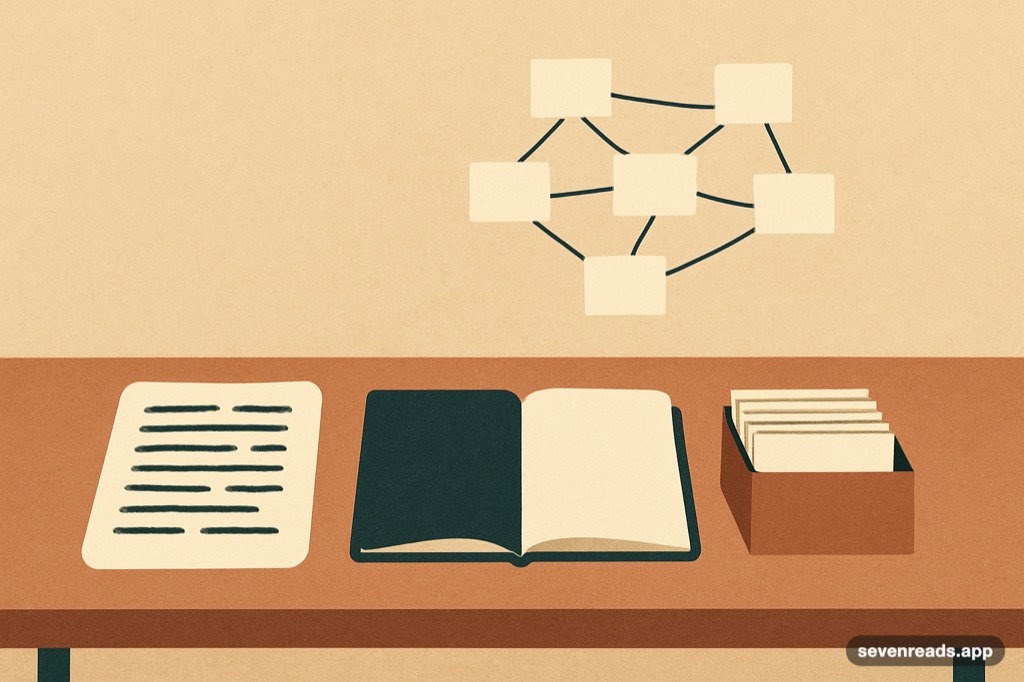
Every book note-taking system is some arrangement of three layers — capture (marking what matters), processing (restating it in your words), and connection (linking it across books) — and the famous methods differ mainly in how far up that stack they climb. Marginalia stops at capture-plus-reaction; the commonplace book adds curation; progressive summarization adds distillation passes; Zettelkasten builds the full linked web. The right question isn't which is best but how far up the stack your reading life actually needs — and the honest answer, for most readers, is lower than the productivity literature suggests.
Here's each system by its layer, and a decision rule that prevents the meta-trap.
Capture and synthesis are built into Seven Reads — the system's foundation, automated.
Get Seven ReadsLayer one systems: marginalia and highlights
Annotation is the foundation everyone should run: cheap marks while reading, short reactions at pauses. Its virtue is zero overhead — it never competes with reading itself — and its ceiling is retrieval: marks live where they were made, so their value depends on returning to the book. Digital annotation raises that ceiling substantially (searchable, reviewable as a set) without adding cost, which is why it's the one layer with no downside case. If you do nothing else, do this.
Layer two: the commonplace book
The commonplace tradition adds selection and relocation: passages worth keeping get promoted out of their books into one curated collection, attributed and revisited. The promotion step is real processing — deciding what earns permanence — and the single collection enables the first cross-book effects, since Aurelius ends up shelved beside a business memoir. Cost: a transfer habit. Payoff: an arsenal of your reading's best, pre-vetted by your own judgment. This is the highest layer most readers ever need.
Layer three and four: distillation and the web
Progressive summarization runs repeated passes over captured notes — bolding the best of the highlights, then the best of the bold — producing ever-denser cores; it suits readers who revisit notes for output (writing, teaching) and is busywork for those who don't. Zettelkasten, the famous card-web method, climbs all the way: every idea gets restated atomically in your own words and explicitly linked to related notes, so the collection compounds into a thinking partner that surfaces unexpected adjacencies. It genuinely works — for the researchers and writers whose output justifies its real, permanent overhead. The failure mode is equally real: elaborate webs built by readers with no output need, maintained for a month, abandoned with guilt. The system was designed for producing prolific scholarship, not for reading well; borrowing its machinery without its purpose buys cost without benefit.
The decision rule
Match the stack to the output. Reading for pleasure and growth: layer one, plus a synthesis note per finished book — five minutes that captures most of layer two's value. Reading that feeds writing or teaching: add the commonplace collection, maybe distillation passes on the books you'll cite. Genuine research across years: Zettelkasten earns its keep. And one meta-rule: any hour spent optimizing the system was an hour not reading — when in doubt, read the next book and let the notes stay simple. The systems serve the shelf, never the reverse.
Frequently asked questions
What's the best note-taking system for books?
The one matching your output: annotation plus a per-book synthesis note covers readers; a commonplace collection adds cross-book value for writers; Zettelkasten repays only sustained research output. Overbuilding is the common failure.
Is Zettelkasten worth it for ordinary reading?
Usually not — its atomic-note-and-link overhead was designed to feed prolific scholarly output. For reading well, annotation and a five-minute synthesis per book capture most of the value at a twentieth of the cost.
What are the three layers of book notes?
Capture (marks and highlights while reading), processing (restating what mattered in your own words), and connection (linking ideas across books). Every named system is some climb up that stack.
Foundation automated, judgment yours.
Seven Reads captures highlights with sources, keeps notes on the passage, and drafts the per-book synthesis from your own thinking — layers one and two, built in.
Get Seven Reads