How to Keep a Commonplace Book
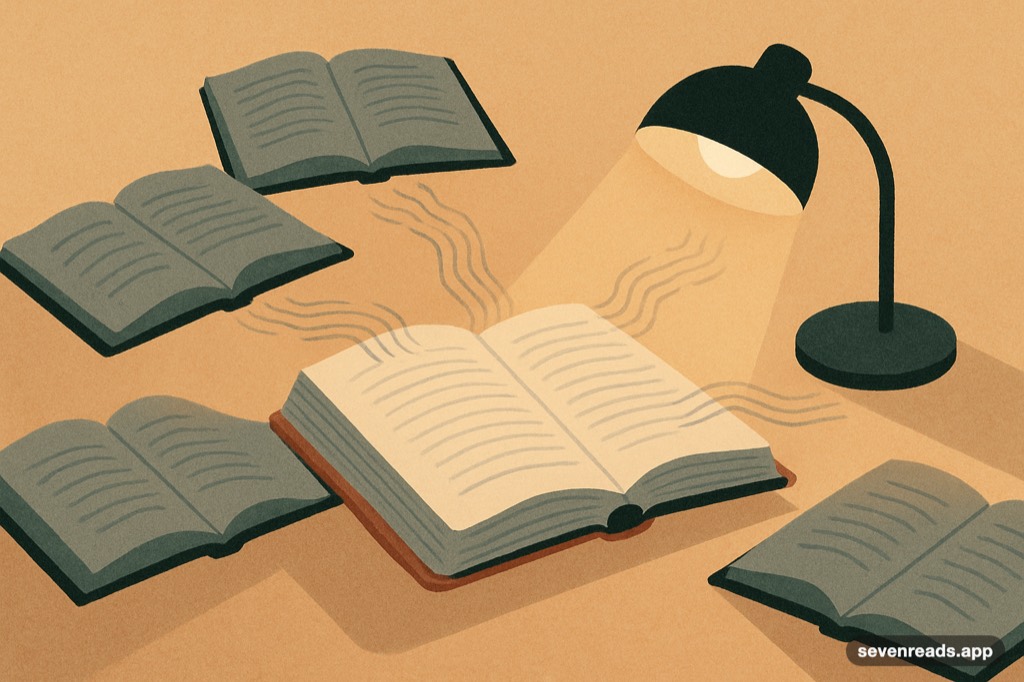
A commonplace book is a personal collection of passages worth keeping — quotations, arguments, images, facts — copied from your reading into one place, under your own organization. The practice is centuries old (Renaissance scholars were trained in it; Milton and Jefferson kept famous ones) and its purpose is precise: not decoration but equipment — a curated arsenal of the best things you've encountered, ready for thinking, writing and living. It is emphatically not a diary: the material is other people's words; the curation is you.
Here's what the practice does, the minimal method, and how the digital version removes the labor that killed most attempts.
Your Seven Reads highlights are a commonplace book that assembles itself.
Get Seven ReadsWhat collecting passages actually does
Three things, each stronger than it looks. Selection is thinking: deciding a passage earns permanent keeping forces the judgment "why does this matter?" — processing that mere reading skips. Copying is encoding: the tradition insisted on transcribing by hand, and the instinct was sound — reproduction slows you into the sentence's actual construction (typing does most of this; the crucial part is passing the words through you). Accumulation is combinatorial: a passage from Marcus Aurelius shelved beside one from a business memoir starts a conversation neither book contains — the commonplace book becomes the room where your reading meets itself. Writers keep them because they're generative: dry material for essays, toasts, decisions and consolations, pre-vetted by your own past judgment.
The minimal method
One rule and two habits. The rule: attribute everything — author, book, location — because an unattributed gem is unusable (and eventually gets misremembered as your own). Habit one: capture at the pause, not mid-flow — flag passages while reading, transfer the survivors at chapter's end; the delay itself is a filter, since half of what dazzled mid-page doesn't survive an hour. Habit two: revisit on schedule — monthly is enough; a commonplace book that's never reread is a transcription service. Organization can stay crude (chronological with a rough tag) — search and rereading beat elaborate taxonomies that become their own hobby.
The digital version that maintains itself
The historical practice demanded real labor, which is why most modern attempts die in week three. But notice what the practice reduces to: highlights, attributed automatically, gathered somewhere reviewable. That's the annotation layer of a digital reader, doing commonplace bookkeeping as a side effect: every highlight is captured with its source and position, your notes attach your own thinking to each entry, and the collection is searchable across every book you've read. What remains genuinely yours to do is the tradition's soul — the curation pass, returning monthly to ask which entries still earn their place — and the cross-book noticing, which no automation should take, because the noticing is the compounding.
Start this week, at this size
The whole barrier to entry: pick the location (a notebook, a document, your reader's highlight collection), adopt the attribution rule, and transfer five passages from the book you're currently reading. Five, not fifty — the practice's value curve rises with age and revisits, not initial volume. In a year the collection will contain a few hundred entries selected by your own best judgment, which is more usable wisdom than most shelves of unmarked books ever yield.
Frequently asked questions
What is a commonplace book, exactly?
A personal, attributed collection of passages worth keeping from your reading — quotations, arguments, images — organized however serves you. Centuries of scholars and writers kept them as thinking equipment, not diaries.
What's the difference between a commonplace book and a journal?
Source: a journal records your life in your words; a commonplace book collects other people's best words, curated by your judgment. Notes on the entries can be yours — the raw material isn't.
Do digital highlights count as a commonplace book?
They're the capture layer, automated — attributed, searchable, gathered. What upgrades them to the real practice is the human part: a regular curation pass and cross-book rereading, which is where the tradition's value always lived.
Let the capture layer run itself.
Seven Reads gathers every highlight with its source, keeps your notes on the passage, and hands you the collection — the curation stays yours.
Get Seven Reads