The Best Translation of the Bhagavad Gita (and the Free One)
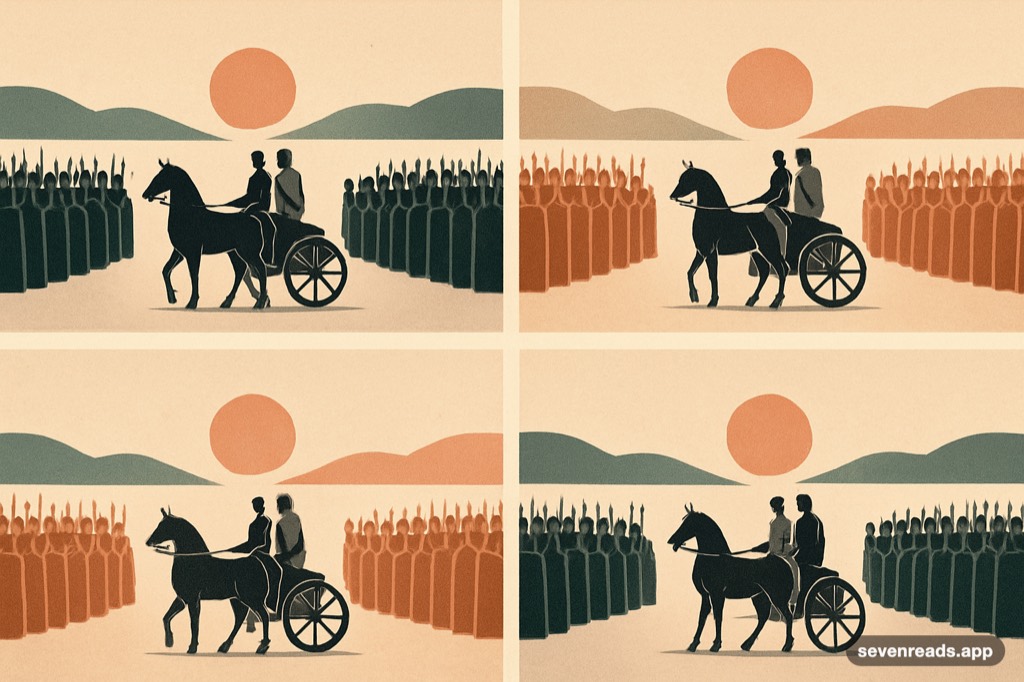
For a first Bhagavad Gita, Eknath Easwaran's translation (1985) is the standard recommendation — clear, warm, with chapter introductions that orient without smothering. Barbara Stoler Miller (1986) is the compact literary classic; Laurie Patton (2008, Penguin) the poetic scholarly choice; Winthrop Sargeant the word-by-word tool for study. The free shelf carries a piece of history: Edwin Arnold's verse translation The Song Celestial (1885) — the version through which Gandhi first met the Gita, and loved all his life.
Here's what kind of book each gives you, and how the free Victorian verse holds up.
The Bhagavad Gita is free in Seven Reads — start reading today.
Get Seven ReadsWhat you're choosing between
The Gita is 700 verses of Sanskrit poetry — a battlefield dialogue in which the warrior Arjuna, paralyzed before a war against his own kin, is counseled by Krishna on duty, action and the self. Translations split by purpose. Devotional-accessible: Easwaran (a spiritual teacher, but a careful one) renders it for readers who want the teaching to land; his three-volume commentary exists separately for depth. Literary: Miller's spare free verse is the version English professors assign — the poem as poem. Scholarly-poetic: Patton keeps the verse feel with academic precision. Study: Sargeant prints Sanskrit, grammar and English word-by-word — a machine for going deep. All render the same dialogue; the difference is whether the frame is practice, poetry or philology.
Arnold's Song Celestial, honestly
Arnold — Victorian poet and journalist — turned the Gita into flowing English blank verse, and the result made history twice: it carried the poem to the West, and it carried it to Gandhi, who read the Gita first in Arnold's English as a law student in London and called it his "spiritual dictionary." The translation's virtues are real: it's complete, reverent, and often genuinely beautiful. Its costs: Victorian diction ("thou," "hath"), occasional Christian-inflected word choices ("sin," "Lord"), and looseness where the Sanskrit is technical. For meeting the poem — especially its central ideas — it works; for parsing chapter 2's terminology, moderns are sharper. (Gutenberg files it under its full Victorian title, which is why the free shelf's copy credits Arnold rather than announcing "Bhagavad Gita" — same book.)
Choosing in one minute
First read, teaching-forward: Easwaran. Literature course or poetry-first: Miller. Scholarly but readable: Patton. Free tonight: Arnold, in good company — you'll be reading the same English Gandhi did. The whole poem is short — two to three hours — so the two-version method works here as well as anywhere: Arnold free for the encounter, one modern for the precision.
A note on commentary editions
The Gita has carried commentaries for over a millennium (Shankara's is the classical landmark), and many modern editions bundle heavy interpretation from specific traditions. Nothing wrong with that — but for a first read, a clean text with light notes (any of the four above) lets the dialogue speak before the schools do. The commentaries are richer once you know what's being argued about.
Frequently asked questions
Which Bhagavad Gita translation is best for beginners?
Eknath Easwaran's — clear, warm, with orienting chapter introductions. Barbara Stoler Miller's compact literary version is the common classroom alternative.
Is the free Edwin Arnold Gita translation good?
It's the Victorian verse version Gandhi first read and treasured — complete, reverent, often beautiful, with dated diction and occasional looseness. Excellent for meeting the poem; pair with a modern for precision.
How long does the Bhagavad Gita take to read?
Two to three hours — 700 verses, 18 short chapters. Its density invites rereading; many readers do a chapter a day for a few weeks instead of one sitting.
Read the same lines Gandhi did.
The Bhagavad Gita is free in Seven Reads — start reading today.
Get Seven Reads