Active Reading: Seven Techniques That Work
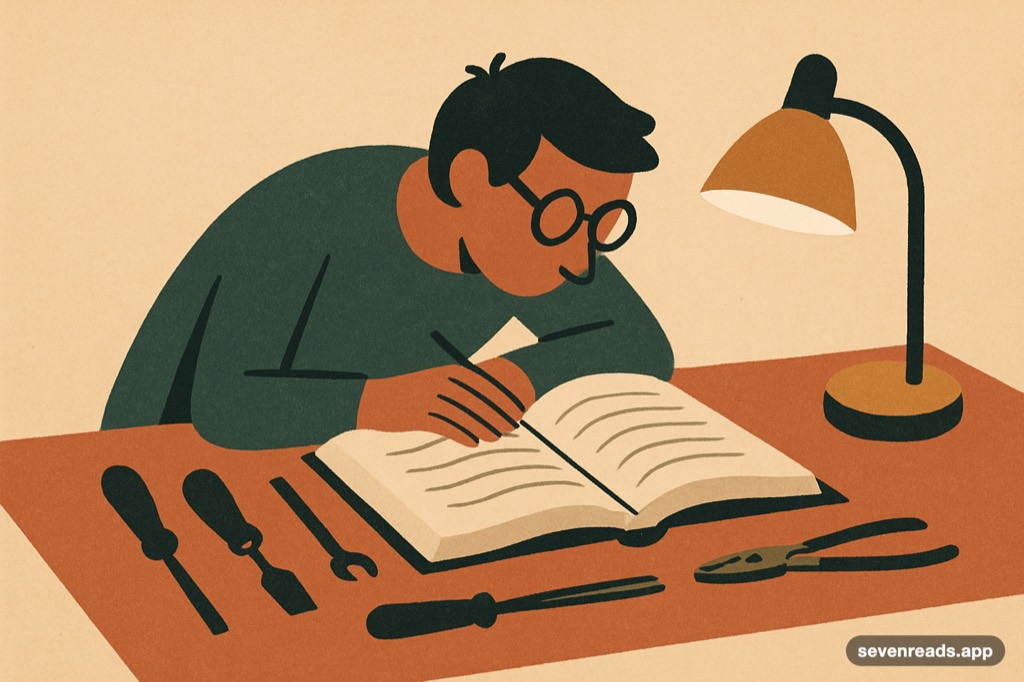
Active reading means processing a text instead of merely traversing it — and the techniques that genuinely work are the ones that force generation: producing questions, predictions, summaries and objections rather than consuming words. The passive-to-active shift is the single largest upgrade available to adult readers, worth more than any speed gain, because comprehension and retention follow processing depth almost mechanically.
Here are seven techniques with real evidence behind them, ordered by where they fit in a reading session.
Seven Reads builds the questioning and retrieval techniques into the page itself.
Get Seven ReadsBefore and during: aim, then interrogate
1. Preview with questions. Two minutes before starting: what kind of book, what's its question, what do I want from it? Priming turns reading into answer-hunting — comprehension research has endorsed versions of this since the 1940s. 2. Predict at chapter breaks. Guess where the argument or plot goes next; prediction creates stakes, and being wrong is more instructive than being told. 3. Interrogate as you go. The elaborative questioning that research keeps validating: why is this true? Why here? What would the author say to my objection? Asking mid-page — of the margin, or a companion that answers — converts intake into integration. 4. Mark for the return. Cheap marks now, real notes at the pause — the two-moment annotation structure that preserves momentum while capturing reactions.
After: retrieve, restate, connect
5. Retrieve before reviewing. At every chapter end, the two-minute version: summarize from memory first, then check. Retrieval practice is the most replicated finding in learning science, and the order — recall, then verify — is the entire trick. 6. Teach it back. Explain the chapter to someone (or something) in plain words; the gaps you hit are your actual comprehension map. Teaching-expectation studies show even anticipating explanation deepens processing. 7. Return on a spacing schedule. Revisit your marks and notes at widening intervals — days, weeks, a month. Spacing beats massed review by wide margins in every domain tested, and it's the step that converts a well-read book into a kept one.
The techniques that don't survive scrutiny
Honesty about the popular ones: highlighting alone ranks among the weakest strategies in the research — capture without processing; rereading whole chapters produces fluency's warm feeling without recall's substance; and speed reading at comprehension-preserving rates is mostly a myth. Each fails for the same reason the seven above work: no generation, no depth. The pattern is the takeaway — anything that makes you produce beats anything that has you re-consume.
Fitting it into real reading
The full stack sounds heavy; the working version is light: one minute of preview, questions as they arise, marks as they strike, two minutes of retrieval at chapter ends, one spaced return pass per book. Total overhead: perhaps ten percent of reading time, repaying multiples of that in retention — the same trade the remembering system makes, because active reading is what remembering systems are made of.
Frequently asked questions
What is active reading in simple terms?
Reading that makes you produce — questions, predictions, summaries, objections — instead of only consume. Processing depth drives comprehension and memory, and generation is what creates depth.
What's the single most effective active reading technique?
Retrieval at chapter ends: summarize from memory first, then check the text. It's the most replicated result in learning science, takes two minutes, and outperforms rereading by wide margins.
Does highlighting count as active reading?
Only as capture: highlighting alone ranks poorly in the research because nothing is generated. It becomes active when paired with notes in your own words and a later retrieval pass over the marks.
Make the page ask back.
Seven Reads puts questioning, recap and quiz-me on the page you're reading — active reading with the machinery built in.
Get Seven Reads