Winnie the Pooh Characters: The Original Book Cast
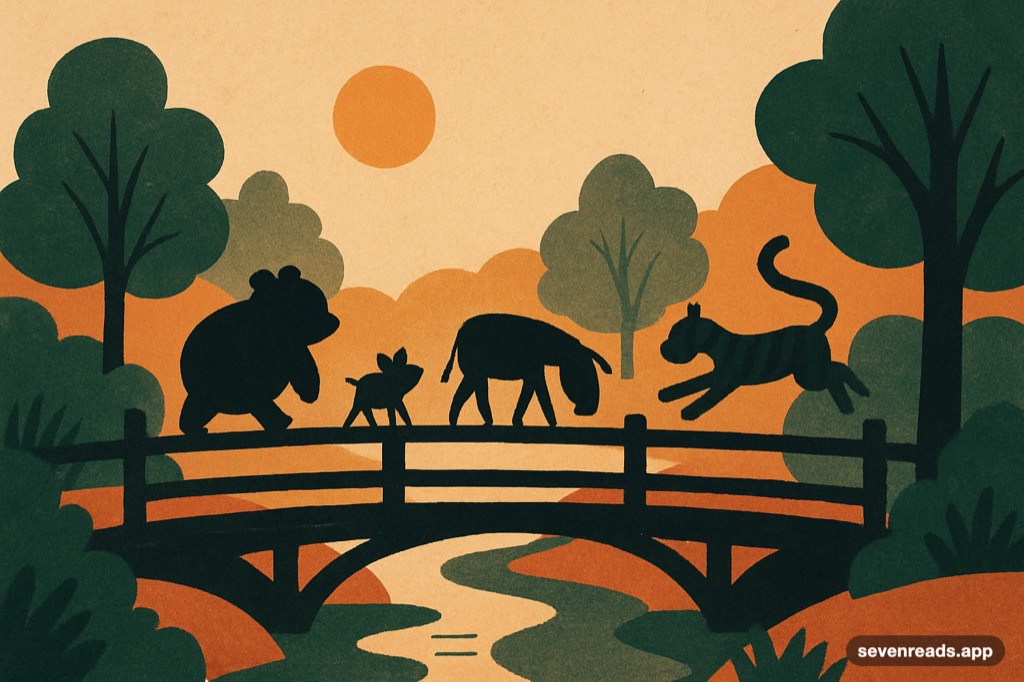
The original Winnie-the-Pooh cast is smaller and stranger than the screen versions suggest: A. A. Milne's two story books — Winnie-the-Pooh (1926) and The House at Pooh Corner (1928) — contain nine characters, each built from a real toy in his son's nursery, each carrying one precisely observed human temperament. Both books are now in the public domain, which means the originals — with E. H. Shepard's line drawings and Milne's very funny, very dry prose — are free to read. Here's everyone, as Milne wrote them.
The core four, the Kanga household, the late arrival who stole the franchise, and what the films changed.
Winnie-the-Pooh is free in Seven Reads — start reading today.
Get Seven ReadsThe core four
Winnie-the-Pooh — "a Bear of Very Little Brain," and the books' running joke is that he isn't: Pooh's dim moments alternate with flashes of accidental genius (he invents the Poohsticks game, rescues Piglet with an umbrella, composes constant verse). Milne's Pooh is defined by appetite, loyalty, and hums — his little songs are scattered through every chapter. Piglet — a Very Small Animal, the books' anatomy of anxiety and the courage that coexists with it; his grandest moment ("Piglet Does a Very Grand Thing") is late-book payoff. Eeyore — the gloomy donkey, and in Milne far funnier and pricklier than his screen version: his gloom is performed at his friends with magnificent passive-aggression ("Thanks for noticin' me" is the films; Milne's Eeyore gets whole sarcastic paragraphs). Christopher Robin — the boy the wood belongs to: part playmate, part deity, summoned whenever events exceed animal competence. The books' famous last chapter, in which he begins school and the wood must absorb it, is one of children's literature's genuinely moving endings.
The establishment: Owl and Rabbit
Owl — the wood's intellectual, who cannot actually spell (his signboard reads "WOL"): Milne's affectionate portrait of credentialed confidence. Rabbit — the organizer: plans, committees, captures-and-censuses, and a large extended family of Friends-and-Relations; his schemes (kidnapping Roo, "unbouncing" Tigger) supply several plots and always collapse. Owl and Rabbit are the only two characters not based on nursery toys — Milne added them as the wood's adults, which explains their shared genre of self-importance.
The Kanga household, and the late arrival
Kanga — the wood's only mother, whose response to Rabbit's kidnapping scheme (calmly bathing the kidnapper) is the books' best comic chapter. Roo — her fearless joey. Tigger — the franchise-stealer, who doesn't exist in the 1926 book at all: he bounces in early in The House at Pooh Corner (1928), announces that Tiggers are the best at everything, and spends his debut discovering, dish by dish, what Tiggers actually eat. Both books are needed for the full cast — and both are public domain now.
Book versus screen
The films' Gopher is an invention ("I'm not in the book," he says — a genuine in-joke); the red shirt is merchandising; and the films soften Milne's two sharpest instruments, Eeyore's sarcasm and the narrator's dry asides to Christopher Robin. What only the books have: Shepard's illustrations, the hums in full, and prose that works twice — once for the child being read to, once for the adult reading. They're short (two evenings each), and rereading them as an adult is a well-documented pleasure: the wood turns out to be a complete taxonomy of the people you work with.
Frequently asked questions
Who are the original Winnie-the-Pooh characters?
From Milne's books: Pooh, Piglet, Eeyore, Owl, Rabbit, Kanga, Roo, Christopher Robin — and Tigger, who first appears in the second book, The House at Pooh Corner (1928).
Is Tigger in the original Winnie-the-Pooh book?
Not the 1926 one — Tigger bounces in near the start of The House at Pooh Corner (1928), announcing that Tiggers are the best at everything and then discovering what they actually eat.
Is Winnie-the-Pooh in the public domain?
Yes — the 1926 book entered the US public domain in 2022 and The House at Pooh Corner in 2024, including Shepard's original illustrations from those volumes. The Disney versions remain under copyright.
The wood, as Milne wrote it.
Winnie-the-Pooh and The House at Pooh Corner are free in Seven Reads — start reading today.
Get Seven Reads