Where to Start With the Greeks: Best Books in Order
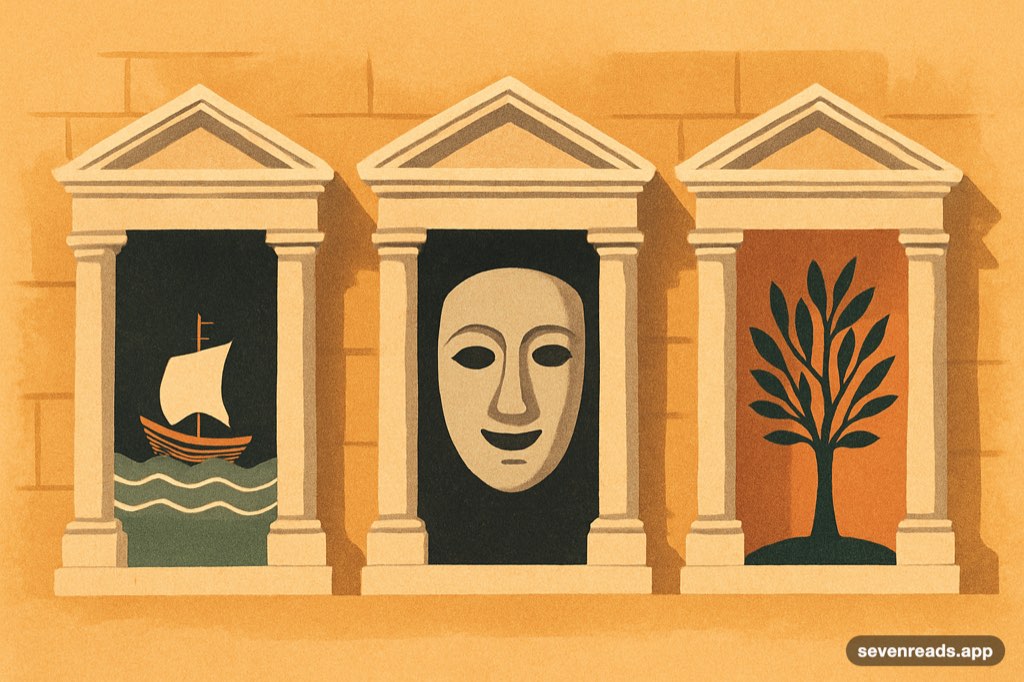
Start the Greeks with the Odyssey — the most purely enjoyable door into the ancient world — then Sophocles' Oedipus the King for tragedy at its most perfect, then Plato's Apology for philosophy at its most dramatic. One text from each of the three great forms, each short or swift, each the best door into its room. The Greeks wrote the founding versions of nearly everything literature does; the trick is entering by the doors built for pleasure rather than the ones built for scholars.
Here's the path, room by room, and where each leads next.
Homer, Sophocles and Plato are all free in Seven Reads — with every god and general identified.
Get Seven ReadsFirst room: epic — the Odyssey
Monsters, disguises, a homecoming heist: the first-timer's guide covers the structure (hero missing for four books, monsters in a flashback), and it's only about eight hours — the cheapest great epic there is. It also quietly furnishes everything after: the gods, the heroes, the Trojan aftermath that tragedy assumes you know. Then, if the epic room holds you: the Iliad — angrier, greater, and easier with the Odyssey's world in your head.
Second room: tragedy — Oedipus the King
One evening, one perfect machine: a king investigates a plague's cause, and the investigation is the trap. Aristotle used it as the model tragedy for good reason — the dramatic irony (the audience knows; he doesn't) is the form's engine at maximum compression, and it plays as a detective story where the detective is the answer. Then, if tragedy holds you: Sophocles' Antigone (the individual against the state, still assigned because still unresolved) and Aeschylus' Oresteia — the trilogy that invents the courtroom as civilization's answer to the revenge spiral.
Third room: philosophy — the Apology
Socrates on trial for his life, defending the questioning life to the jury that will end it — philosophy's best entrance because it's drama first: stakes, a voice, a verdict. An afternoon's read, and it installs the stakes that make every dialogue after it matter. Then the Symposium for pleasure and the Republic for depth, per the Plato order — and Aristotle only after Plato, as the brilliant student arguing back.
The room most people skip, wrongly — and practical notes
Herodotus. The Histories is the ancient world's great miscellany — wars, marvels, gossip, anthropology — and reads in browsable episodes rather than as a march; it's the Greek book most like scrolling a fascinating feed, and the natural fourth room. Practical notes for all of it: public-domain translations are sturdy (prose Homer reads like a novel; Jowett's Plato remains standard), names are the one real tax — gods, heroes, factions — and asking who's-who from your page pays here more than anywhere, since the Greeks assumed an audience raised on these stories. You're joining twenty-eight centuries of readers; the material was built to hold an audience, and it still does.
Frequently asked questions
What should I read first from ancient Greece?
The Odyssey — the most enjoyable entry to the ancient world, about eight hours, and it furnishes the gods and heroes everything else assumes. Then Oedipus the King for tragedy and Plato's Apology for philosophy.
Should I read the Iliad or the Odyssey first?
The Odyssey — it's shorter, more adventure-shaped, and stands fully alone. The Iliad is the greater poem by many judgments, and it lands better with the Odyssey's world already familiar.
Are the Greek classics hard to read?
Less than their age suggests in good prose translations — the real tax is name-density and assumed backstory, both solved by asking as you go. The forms themselves (adventure, mystery-shaped tragedy, courtroom drama) are the ancestors of everything modern readers already like.
Three doors, three evenings to start.
The Odyssey, Oedipus and the Apology are free in Seven Reads — start reading today.
Get Seven Reads