Where to Start With Hemingway: Best Books in Order
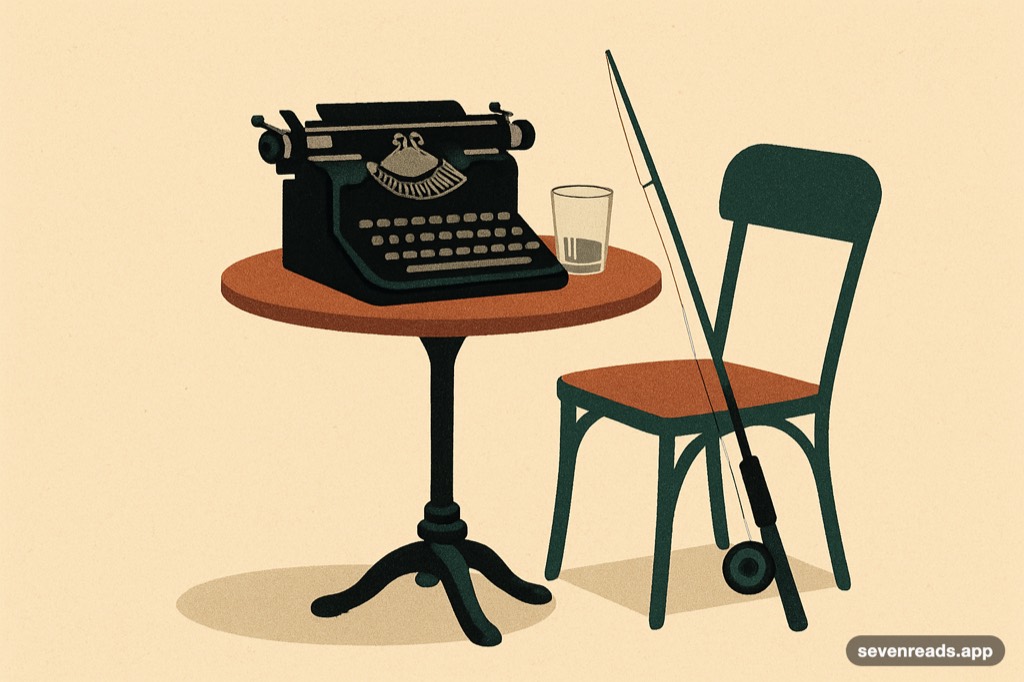
Start Hemingway where he started: the early Paris work. In Our Time (1925) — the story collection that announced the style — then The Sun Also Rises (1926), the first novel and still the purest one, then A Farewell to Arms (1929). That's the arc that changed English prose, and — a fact that's newly useful — all three have now entered the public domain, so the whole first act is free. The later landmarks (For Whom the Bell Tolls, The Old Man and the Sea) remain in copyright and remain worth buying; here's the honest map of both halves.
The order, the famous style and how to actually read it, and what's free versus not.
Early Hemingway is free in Seven Reads — start reading today.
Get Seven ReadsFirst: In Our Time — the style, arriving
The 1925 collection alternates stories with one-paragraph vignettes of war and bullfighting, and contains "Big Two-Hearted River" — a man fishing, nothing else on the surface, everything underneath — which is the entire Hemingway method in one story. His "iceberg theory," stated later: you may omit anything you know, and the omission strengthens the story; the reader feels what isn't said. Reading the early stories first teaches you to read the novels — to notice that the dialogue's smallness is load-bearing and the weather is never just weather. The Nick Adams stories here are also the autobiography he never wrote plainly.
Second: The Sun Also Rises — the first novel, still the purest
Paris and Pamplona, 1925: a circle of expatriates drinking toward the bullfights, narrated by a war-wounded journalist in love with a woman he cannot have. Nothing "happens" in the plot summary and everything happens in the omissions — the wound, the war, the faith and money nobody discusses. It made the "Lost Generation" a household phrase (Stein's line, used as epigraph, answered by the book's other epigraph from Ecclesiastes — the argument between the two is the novel). Six hours, and the best single test of whether Hemingway is your author.
Third: A Farewell to Arms — the style at full power
The Italian front, an ambulance driver, a love affair conducted against collapse: Hemingway's war novel earns its reputation in the retreat from Caporetto — sustained narration nobody has improved on — and in a final chapter whose plainness is the point. He rewrote the ending dozens of times (the drafts survive; his explanation: "getting the words right"). With 1929 works now public domain, this is the newest major Hemingway on the free shelf, and the natural third step.
The later shelf, honestly
For Whom the Bell Tolls (1940) — the Spanish Civil War epic — and The Old Man and the Sea (1952) — the Nobel-clinching fable, readable in two hours — are still in copyright: buy or borrow them, and do; the old man and the marlin is the gentlest entry for readers who find the early books too dry. A Moveable Feast, the posthumous Paris memoir, is the dessert course. And the short stories throughout ("The Snows of Kilimanjaro," "A Clean, Well-Lighted Place") may be the most durable Hemingway of all — the iceberg method was built for the short form, and as with Kafka, starting with what an author perfected beats starting with what made him famous.
Frequently asked questions
What should I read first by Hemingway?
In Our Time — the early stories that announced the style — then The Sun Also Rises, his first and purest novel. The stories teach you how to read the omissions the novels are built on.
Which Hemingway books are in the public domain?
The first act: In Our Time (1925), The Sun Also Rises (1926), Men Without Women (1927) and A Farewell to Arms (1929) are now public domain in the US. For Whom the Bell Tolls and The Old Man and the Sea are still in copyright.
What is Hemingway's iceberg theory?
His principle that a writer may omit what he knows, and the omission strengthens the story — seven-eighths of the meaning underwater, felt rather than stated. "Big Two-Hearted River" is the standard demonstration.
The Paris decade, free.
In Our Time, The Sun Also Rises and A Farewell to Arms are free in Seven Reads — start reading today.
Get Seven Reads