The War of the Worlds AI: a reading companion that never spoils it
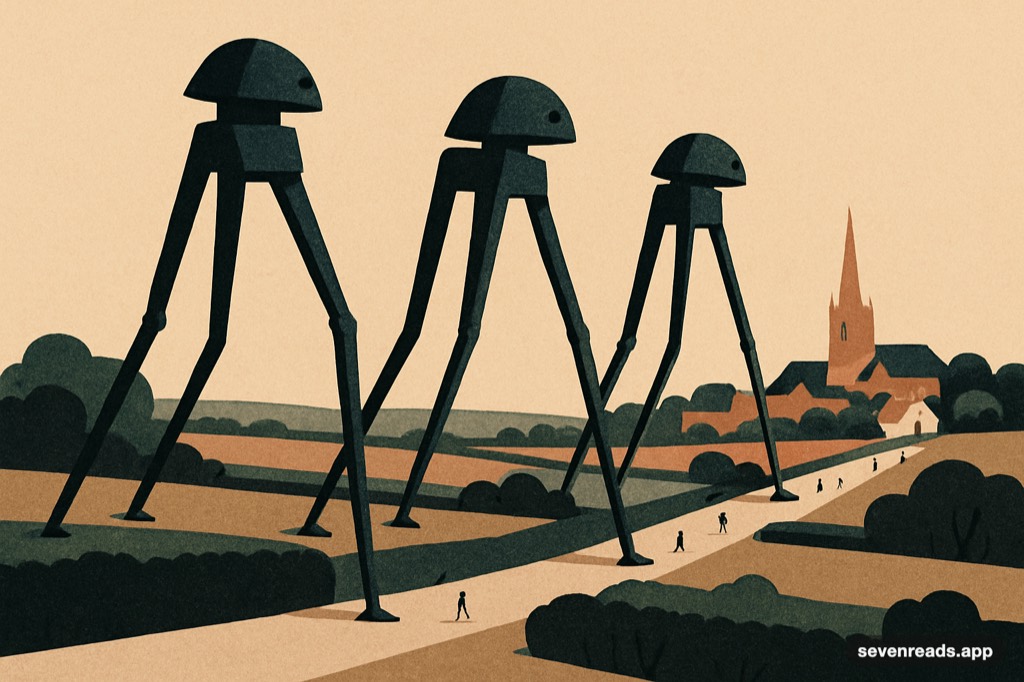
Reading The War of the Worlds with an AI companion means you can ask questions about the book — by typing or by voice — and get answers grounded in the pages you've actually read, never the ones ahead. Every alien-invasion story descends from this one, and almost none kept its coldest idea: the narrator explicitly compares the Martians' regard for humans to ours for animals — invasion as colonialism with the telescope reversed. Wells wrote it walking Surrey lanes, marking real villages for destruction.
The War of the Worlds is free in Seven Reads — start reading today.
Get Seven ReadsWhat readers actually ask about The War of the Worlds
These are the kinds of questions a companion earns its keep on — asked mid-page, answered from the text you've read, without judgment and without leaks:
“Why does the narrator keep comparing Martians to humans?”
It's the book's thesis, stated in the first chapter: beings of superior technology regarding lesser creatures as resources — with explicit reference to what European empires had recently done on Earth. Wells keeps the mirror angled throughout; every Martian atrocity has a colonial echo the first readers caught.
“Who is the artilleryman and why does his section matter?”
A soldier the narrator meets twice — and his second appearance is one of literature's great deflations: grand plans for humanity's underground resistance, tested against what the man actually does all day. It's Wells's verdict on heroic talk, and it lands harder than any tripod.
“Is the science real?”
For 1898, remarkably disciplined — contemporary Mars observations, plausible optics for the heat-ray, and a biological premise the ending takes seriously. Ask the companion what Wells's first readers believed about Mars; the book was riding a real astronomical mania, which is why it terrified.
The spoiler problem with The War of the Worlds
How the invasion resolves is among the most culturally leaked endings in fiction — and one of the most thematically load-bearing, since the mechanism is the book's final argument about empire, biology and hubris. If you've somehow dodged it, you're carrying something rare; a position-aware companion will help you keep it. A general chatbot has read the whole book and will eventually let that knowledge shape an answer. Seven Reads' companion is position-aware: it retrieves only from text before your bookmark, so it cannot reveal what you haven't reached — ask about the ending early and it declines, and tells you where you are instead.
How to read The War of the Worlds with Seven Reads
Add the book from the built-in store — it's one of 50,000+ public-domain classics included free — and just start reading. Highlight what strikes you, add notes when the thought arrives, and ask the companion anything the moment you wonder. When you finish, Seven writes two things: the book's overview, and a synthesis of what you noticed, built from your own notes and questions. If it's your first classic in a while, our guide to starting the classics pairs well with this book.
Frequently asked questions
Can I read The War of the Worlds for free?
Yes. The War of the Worlds is in the public domain, and a well-formatted copy is included free in Seven Reads — one tap adds it to your library, where it reads like any other book, with your position, highlights and notes kept.
Can AI discuss The War of the Worlds without spoiling it?
Only if the AI is position-aware. Seven Reads tracks exactly where you are in The War of the Worlds and answers only from the pages behind your bookmark — everything ahead is structurally excluded, so asking about the ending gets a refusal, not a leak. The ending is famous for its specific mechanism — one of fiction's most spoiled resolutions.
How long does it take to read The War of the Worlds?
Around 4 hours for most readers. At twenty minutes a day, that's roughly 2 weeks — and a streak matters more than any single sitting.
More classics to read with AI
- All 77 classics you can read with AI — the full list
- The Time Machine AI — H. G. Wells
- The Invisible Man AI — H. G. Wells
- Twenty Thousand Leagues Under the Seas AI — Jules Verne
- How the no-spoilers guarantee works