Siddhartha AI: a reading companion that never spoils it
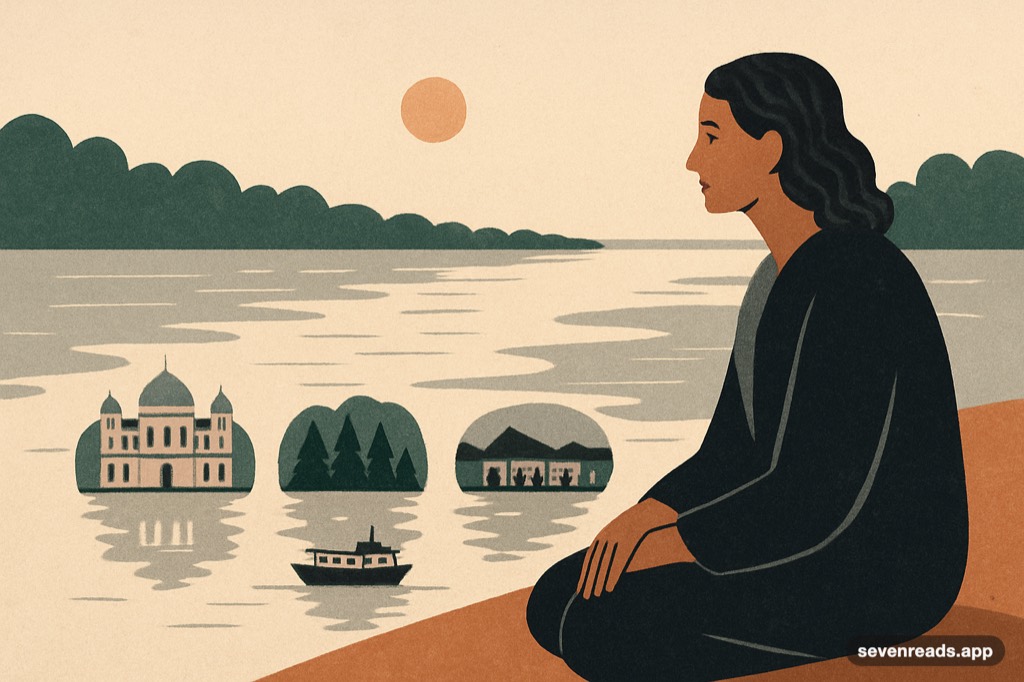
Reading Siddhartha with an AI companion means you can ask questions about the book — by typing or by voice — and get answers grounded in the pages you've actually read, never the ones ahead. A Brahmin's son walks away from every teacher — including, in the book's boldest scene, the Buddha himself — to learn what can't be taught. It's short, hypnotic, and built in symmetrical halves: spirit first, world second, river last. The ideas go deep fast, which is where having someone to ask pays off.
Siddhartha is free in Seven Reads — start reading today.
Get Seven ReadsWhat readers actually ask about Siddhartha
These are the kinds of questions a companion earns its keep on — asked mid-page, answered from the text you've read, without judgment and without leaks:
“Is this the story of the Buddha?”
No — and the confusion is intentional. Siddhartha shares the Buddha's birth name and meets him as a separate character, then declines to follow him. Ask about the historical layer and you'll get what the encounter means without the book's later turns.
“What do the Sanskrit terms actually mean?”
Atman, Om, samsara — Hesse uses them precisely, and a quick in-place answer beats a Wikipedia detour that will happily discuss the ending. This is the ideal book for asking small questions the moment they arise.
“Why does he leave the Buddha?”
His argument — that teachings can transmit knowledge but not experience — is the novel's thesis stated in chapter three, then tested for a lifetime. Ask the companion to hold his reasoning up against each later stage as you reach it; the book is a proof unfolding.
The spoiler problem with Siddhartha
The book's power is cumulative: each stage of the life looks complete until the next reveals what it lacked, and the closing pages gather every stage into one image. A synopsis collapses that staircase into a moral, which is precisely what the novel argues wisdom can never be. A general chatbot has read the whole book and will eventually let that knowledge shape an answer. Seven Reads' companion is position-aware: it retrieves only from text before your bookmark, so it cannot reveal what you haven't reached — ask about the ending early and it declines, and tells you where you are instead.
How to read Siddhartha with Seven Reads
Add the book from the built-in store — it's one of 50,000+ public-domain classics included free — and just start reading. Highlight what strikes you, add notes when the thought arrives, and ask the companion anything the moment you wonder. When you finish, Seven writes two things: the book's overview, and a synthesis of what you noticed, built from your own notes and questions. If it's your first classic in a while, our guide to starting the classics pairs well with this book.
Frequently asked questions
Can I read Siddhartha for free?
Yes. Siddhartha is in the public domain, and a well-formatted copy is included free in Seven Reads — one tap adds it to your library, where it reads like any other book, with your position, highlights and notes kept.
Can AI discuss Siddhartha without spoiling it?
Only if the AI is position-aware. Seven Reads tracks exactly where you are in Siddhartha and answers only from the pages behind your bookmark — everything ahead is structurally excluded, so asking about the ending gets a refusal, not a leak. The final ferryman chapters resolve a lifetime — arrive at them without a summary.
How long does it take to read Siddhartha?
Around 3 hours for most readers. At twenty minutes a day, that's roughly 1 week — and a streak matters more than any single sitting.
More classics to read with AI
- All 77 classics you can read with AI — the full list
- Tao Te Ching AI — Laozi
- The Metamorphosis AI — Franz Kafka
- Meditations AI — Marcus Aurelius
- How the no-spoilers guarantee works