Ship of Theseus Meaning: The Identity Puzzle
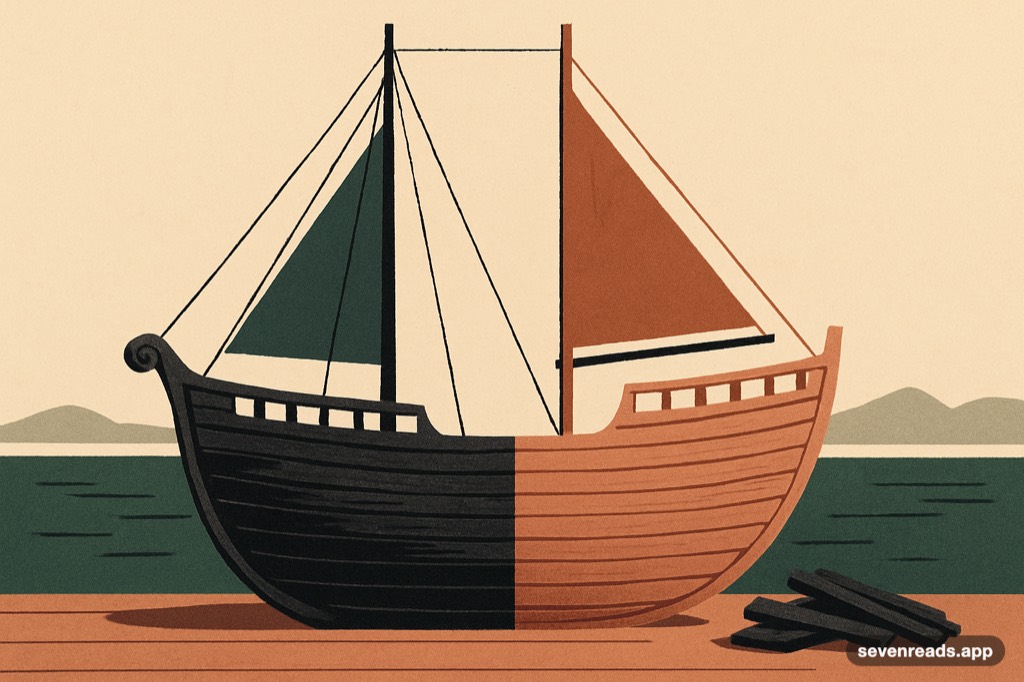
The Ship of Theseus asks: if a ship's planks are replaced one at a time until none of the originals remain, is it still the same ship? The ancient puzzle — preserved by Plutarch as a debate already old in his day — looks like a curiosity and functions like a depth charge: it detonates under our everyday confidence about what makes anything, including you, the same thing over time. Your cells turn over; your beliefs replace themselves; the ship is you.
Here's the puzzle at full strength, the upgrade that made it worse, and the serious answers on offer.
The puzzle's ancient sources and their heirs are free in Seven Reads — start reading today.
Get Seven ReadsThe classic version and the upgrade that ruins everything
Version one is survivable: gradual replacement, one plank at a time, and most people's intuition says identity survives — things persist through change; that's what maintenance means. Then Hobbes added the second ship: suppose someone collects every discarded original plank and reassembles them. Now two vessels sit in the harbor — the continuously repaired ship and the reassembled original — and each has a compelling claim to be the Ship of Theseus. Identity can't belong to both (they're two ships), and every rule that awards it to one seems arbitrary against the other's claim. That's the puzzle at full strength: our concept of "same thing" contains two criteria — continuity of function and sameness of material — that normally travel together and can be forced apart.
The main answers, honestly weighed
Continuity wins: identity follows the unbroken history of maintenance and use — the repaired ship is the ship, the reassembly a reconstruction. This matches how we treat institutions, rivers and bodies, but must explain why origin-material counts for nothing. Matter wins: the reassembled ship is the original — but then identity vanished mid-repair without anyone noticing, which is strange. Convention: there's no fact of the matter — "same ship" is a human bookkeeping practice, and the puzzle just shows the bookkeeping has edge cases. Deflationary, popular among philosophers, and oddly unsatisfying the moment the ship is something you love. Four-dimensionalism: objects are histories, not snapshots — spacetime "worms" — and the two ships are two branching histories sharing an early segment. Elegant, at the price of rethinking what objects are.
Why the puzzle is really about you
The stakes arrive with personal identity: your body replaces most of its material over the years; your memories, tastes and convictions turn over more thoroughly than any hull. What makes forty-year-old you the same person who was seven — responsible for that person's promises, continuous with their memories? Locke answered with psychological continuity (memory chains), inviting his own reassembled-ship problems; the Buddhist tradition answered centuries earlier by biting the bullet — there is no persisting self, just a process conventionally named, a position with striking resemblance to the convention answer above. Every answer to the ship is secretly an answer about persons, which is why the puzzle has outlived every fleet.
Using the puzzle well
It earns its keep as an instrument: run it against a band with no original members, a rebuilt cathedral, a company after complete turnover, a marriage after decades — and watch which criterion your intuition reaches for in each case. The inconsistency you'll find isn't a failure; it's the discovery that "identity" was several concepts wearing one word. That discovery, applied with care, is a good chunk of metaphysics — available from a two-thousand-year-old thought experiment about boat repair, and best pursued in dialogue with the sources.
Frequently asked questions
What is the Ship of Theseus paradox?
If a ship's planks are replaced one by one until none remain, is it the same ship — and if the old planks are reassembled into a second ship, which one is the original? The puzzle forces apart two criteria of identity (continuity and material) that usually agree.
What is the best solution to the Ship of Theseus?
There's no consensus — continuity theories match everyday practice, conventionalism says identity is bookkeeping with edge cases, and four-dimensionalism recasts objects as histories. The puzzle's value is exposing that "same thing" bundles several distinct ideas.
How does the Ship of Theseus apply to personal identity?
Directly: your material and psychology turn over like planks, so what makes you the same person across decades inherits the puzzle. Locke's memory-continuity answer and the Buddhist no-self answer are the two most influential responses.
Run the thought experiment properly.
Plutarch, Locke and the Buddhist sources are free in Seven Reads — start reading today.
Get Seven Reads