Scylla and Charybdis: The Meaning Behind the Phrase
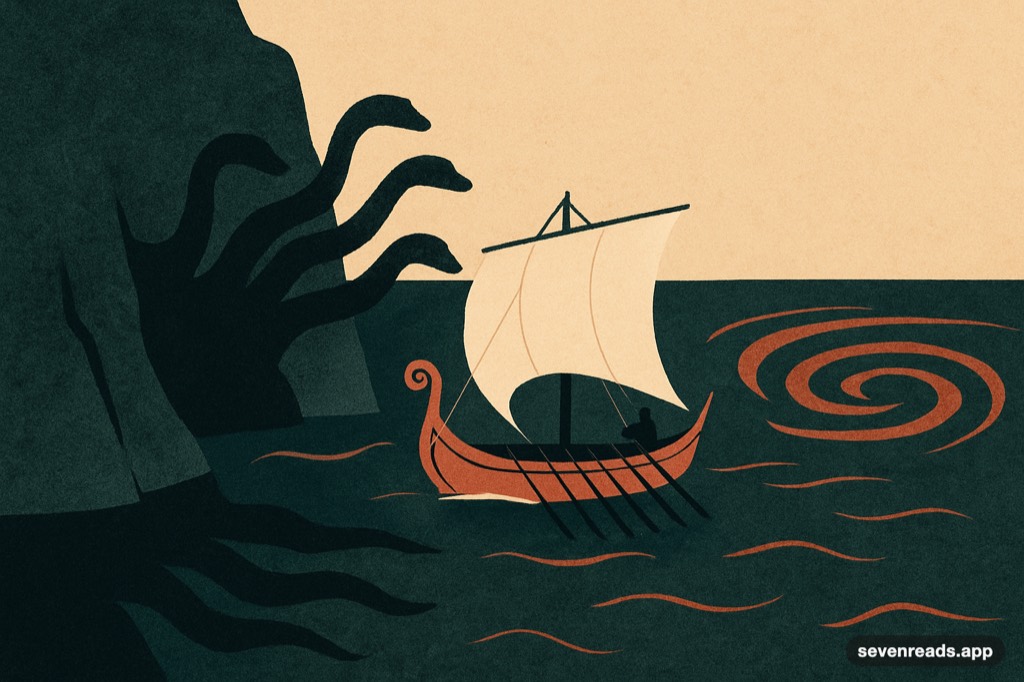
"Between Scylla and Charybdis" means facing two dangers where steering from one pushes you toward the other. But the phrase has a sharper edge than "rock and a hard place," because in the Odyssey it isn't a dilemma of equal evils: Circe tells Odysseus in advance which monster to favor, and why — and his choice, to hug the cliff and lose six men rather than risk the whole ship, is one of literature's oldest lessons in deciding under constraint. The idiom remembers the trap; the poem is about the triage.
Here's the scene, the advice, and why the original beats the paraphrase.
The Odyssey is free in Seven Reads — start reading today.
Get Seven ReadsThe strait
On one side, Scylla: six heads on serpent necks in a sea cliff, each head taking a man from any ship in reach. On the other, close enough that avoiding one means nearing the other, Charybdis: a whirlpool that swallows the sea whole three times a day and vomits it back. The geography is the idea — the strait is too narrow for a safe middle. Later tradition parked the pair at the Strait of Messina between Italy and Sicily, where a real whirlpool obliged.
Circe's advice, and the choice
What the idiom forgets is that Odysseus doesn't face the strait blind. Circe briefs him: don't fight Scylla — she's immortal, and lingering in reach costs more men — and above all stay clear of Charybdis, because the whirlpool doesn't take six sailors, it takes everything. Hug the cliff, keep rowing, accept the loss. It's the poem's coldest arithmetic: certain limited loss beats possible total loss. Odysseus obeys — with one very human failure, arming himself against Scylla despite orders, achieving nothing — and six men are taken screaming while the rest row. Homer lets the cost land: Odysseus calls it the most pitiful sight of all his voyages.
Why the original is more useful than the idiom
"Caught between Scylla and Charybdis" flattens the scene into symmetric doom. The scene itself is a decision framework: when every option costs, compare the worst cases, not the best; pay the bounded cost to refuse the unbounded one; and don't waste effort fighting the cost you already chose to accept (the spear against the immortal is everyone's favorite mistake). Sailors, doctors and risk managers reinvent Circe's briefing constantly. The idiom is a complaint; the episode is a strategy.
Read the whole gauntlet
The strait is one trial in the poem's famous middle stretch — sirens immediately before it, the sun god's fatal cattle just after — all told by Odysseus himself at a banquet, a narrator with every reason to tell it well. The Odyssey runs about 10 hours, the sea-stories are its heart, and the question of how far to trust the teller is half the fun of asking about them.
Frequently asked questions
What does between Scylla and Charybdis mean?
Facing two dangers where avoiding one brings you closer to the other — a forced choice between evils. It comes from the narrow strait Odysseus must thread in Homer's Odyssey.
What were Scylla and Charybdis?
Scylla was a six-headed monster in a sea cliff who took one man per head from passing ships; Charybdis was a whirlpool that swallowed the sea whole. Later tradition placed them at the Strait of Messina.
Which did Odysseus choose, Scylla or Charybdis?
Scylla, on Circe's advice — a certain loss of six men over the whirlpool's risk of losing everyone. The episode is less a dilemma than a lesson in choosing the bounded cost.
The strait is still good advice.
The Odyssey is free in Seven Reads — start reading today.
Get Seven Reads