Pyrrhic Victory Meaning: Winning Your Way to Ruin
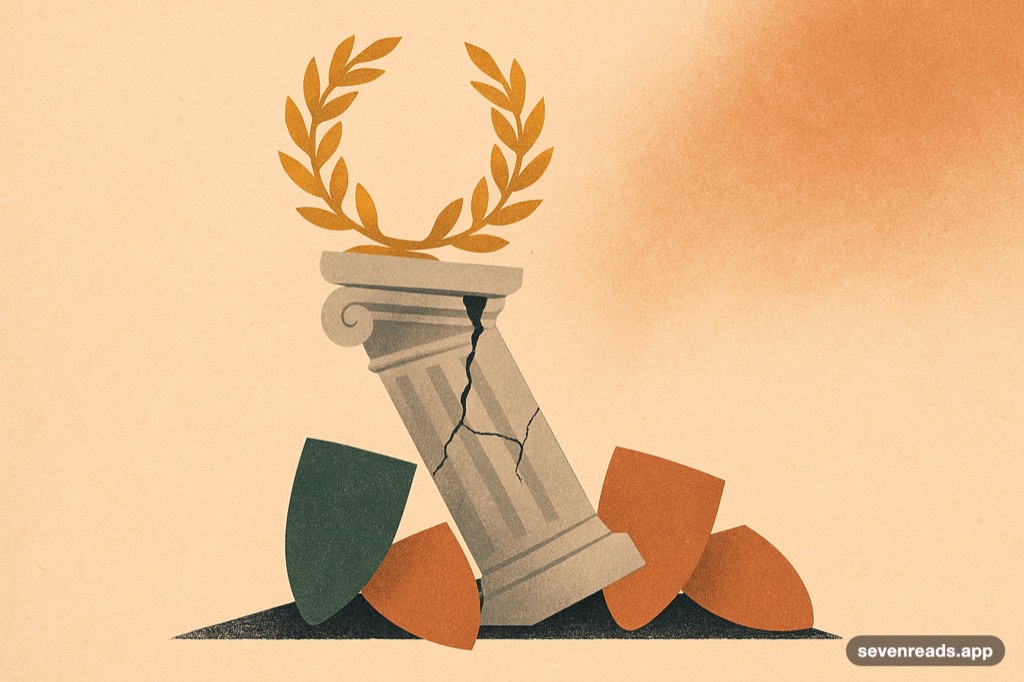
A Pyrrhic victory is a victory that ruins the victor — you win the battle, the court case, the argument, and the winning costs more than losing would have. The name belongs to a real general: Pyrrhus, king of Epirus, one of antiquity's most gifted commanders, who beat the Romans twice in the 270s BC and made the observation that immortalized him. Plutarch records it: congratulated on his second victory, Pyrrhus replied, "If we are victorious in one more battle with the Romans, we shall be utterly ruined."
Here's the campaign behind the phrase, the arithmetic that doomed a brilliant general, and the modern pattern-recognition the concept enables.
Plutarch and The Art of War are free in Seven Reads — start reading today.
Get Seven ReadsThe battles that named it
Rome and Pyrrhus met at Heraclea (280 BC) and Asculum (279 BC), and Pyrrhus won both — his phalanx and war elephants were tactically superior. But the ledgers told another story: his losses included his best troops and nearly all his officers, and he was campaigning far from home with no way to replace them, while Rome — fighting in its own country, with deep manpower — "filled up their ranks," Plutarch says, "as if from a fountain." The insight in Pyrrhus's bitter joke is that victory and defeat are measured in different currencies: battles are scored in the field, wars in the ability to keep fielding. He was winning the scoreboard and losing the arithmetic.
The anatomy of a Pyrrhic victory
Three ingredients, all visible in the original. Asymmetric replacement: both sides pay, but only one can restock. Objective confusion: Pyrrhus's goal was a negotiated peace, and every "win" hardened Rome against negotiating — his victories consumed the very thing they were for. And sunk-cost gravity: each battle's price became the argument for the next one. The concept's practical value is that all three are checkable before the trophy: Who replaces losses faster? Does winning this actually advance the goal, or just the score? Am I continuing because of what's ahead or what's already spent?
Everywhere once you see it
The hostile takeover that saddles the winner with fatal debt. The lawsuit won at the cost of the relationship it was about. The argument you win so thoroughly the marriage loses. Price wars, bidding wars, custody wars — any contest where the frame "win this round" hides the ledger "at what replacement cost." Sun Tzu's Art of War is, at bottom, a whole treatise against Pyrrhic victory — "no country has ever profited from protracted warfare"; the supreme excellence is winning without fighting, precisely because fighting's costs compound. And the concept shades into hubris at the exact point where the winner, flush with the scoreboard, stops doing the arithmetic.
The man himself
Pyrrhus's whole life ran the pattern: brilliant at battles, restless at consolidation, forever winning his way out of one war into another. Hannibal reportedly ranked him among the greatest commanders ever — and he died in a street fight in Argos, felled by a roof tile thrown by an old woman. Plutarch's life of Pyrrhus, a few hours' read, is the classic study of talent without arithmetic; the phrase is its executive summary.
Frequently asked questions
What does Pyrrhic victory mean?
A win whose costs are so severe it amounts to defeat — from King Pyrrhus, who beat Rome twice but lost irreplaceable troops doing it: "one more such victory and we are utterly ruined."
Who was Pyrrhus?
King of Epirus (in northwestern Greece), one of antiquity's best generals — victor at Heraclea and Asculum against Rome in 280–279 BC, ranked by Hannibal among history's greatest commanders, and undone by winning unaffordably.
How do you spot a Pyrrhic victory in advance?
Three checks: who can replace losses faster; whether winning this actually serves the real goal or just the score; and whether you're continuing because of the future or the sunk costs. Pyrrhus failed all three, visibly, and fought on.
Do the arithmetic first.
Plutarch and The Art of War are free in Seven Reads — start reading today.
Get Seven Reads