Moby-Dick AI: a reading companion that never spoils it
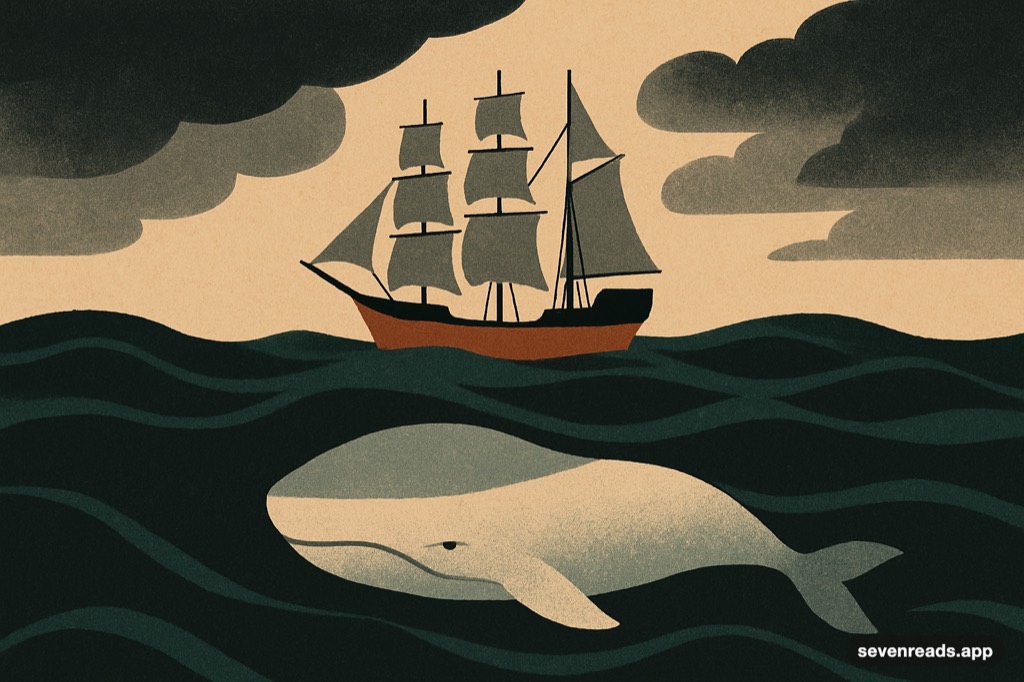
Reading Moby-Dick with an AI companion means you can ask questions about the book — by typing or by voice — and get answers grounded in the pages you've actually read, never the ones ahead. The famous problem is the cetology — whole chapters on whale anatomy and rope — and the famous mistake is skipping them cold. The book alternates story and encyclopedia on purpose, and knowing what each digression is doing turns the slog into the architecture.
Moby-Dick is free in Seven Reads — start reading today.
Get Seven ReadsWhat readers actually ask about Moby-Dick
These are the kinds of questions a companion earns its keep on — asked mid-page, answered from the text you've read, without judgment and without leaks:
“Do I have to read the whale-anatomy chapters?”
You can skim some and survive — but ask what a digression is doing before you skip it. The cetology chapters are Ishmael trying to measure, classify and contain something that refuses containment, which is the novel's whole theme rehearsed in miniature. Some are also very funny, which nobody warns you about.
“Why does the narrator disappear for chapters at a time?”
Ishmael starts as a character and dissolves into a voice — scenes he couldn't have witnessed, stage directions, even a chapter formatted like a play. Readers argue about whether that's a flaw or the design; it's a great question to press the companion on as the shifts happen.
“What drives Ahab, actually?”
The book gives him real speeches about it — the whale as mask, the insult of the universe — and then keeps qualifying them through other characters' eyes. Track how Starbuck's resistance evolves; the Ahab–Starbuck argument is the novel's moral spine.
The spoiler problem with Moby-Dick
Melville delays everything deliberately — Ahab doesn't appear for many chapters, the whale for hundreds of pages — so the book's tension lives in that patience. Knowing how the chase resolves converts one of literature's great endings into a long wait for a known result. A general chatbot has read the whole book and will eventually let that knowledge shape an answer. Seven Reads' companion is position-aware: it retrieves only from text before your bookmark, so it cannot reveal what you haven't reached — ask about the ending early and it declines, and tells you where you are instead.
How to read Moby-Dick with Seven Reads
Add the book from the built-in store — it's one of 50,000+ public-domain classics included free — and just start reading. Highlight what strikes you, add notes when the thought arrives, and ask the companion anything the moment you wonder. When you finish, Seven writes two things: the book's overview, and a synthesis of what you noticed, built from your own notes and questions. If it's your first classic in a while, our guide to starting the classics pairs well with this book.
Frequently asked questions
Can I read Moby-Dick for free?
Yes. Moby-Dick is in the public domain, and a well-formatted copy is included free in Seven Reads — one tap adds it to your library, where it reads like any other book, with your position, highlights and notes kept.
Can AI discuss Moby-Dick without spoiling it?
Only if the AI is position-aware. Seven Reads tracks exactly where you are in Moby-Dick and answers only from the pages behind your bookmark — everything ahead is structurally excluded, so asking about the ending gets a refusal, not a leak. The novel spends 600 pages building toward one encounter; its shape is the suspense.
How long does it take to read Moby-Dick?
Around 14 hours for most readers. At twenty minutes a day, that's roughly 6 weeks — and a streak matters more than any single sitting.
More classics to read with AI
- All 77 classics you can read with AI — the full list
- Heart of Darkness AI — Joseph Conrad
- The Odyssey AI — Homer
- Lord Jim AI — Joseph Conrad
- How the no-spoilers guarantee works