Know Thyself: The Real Meaning of the Phrase
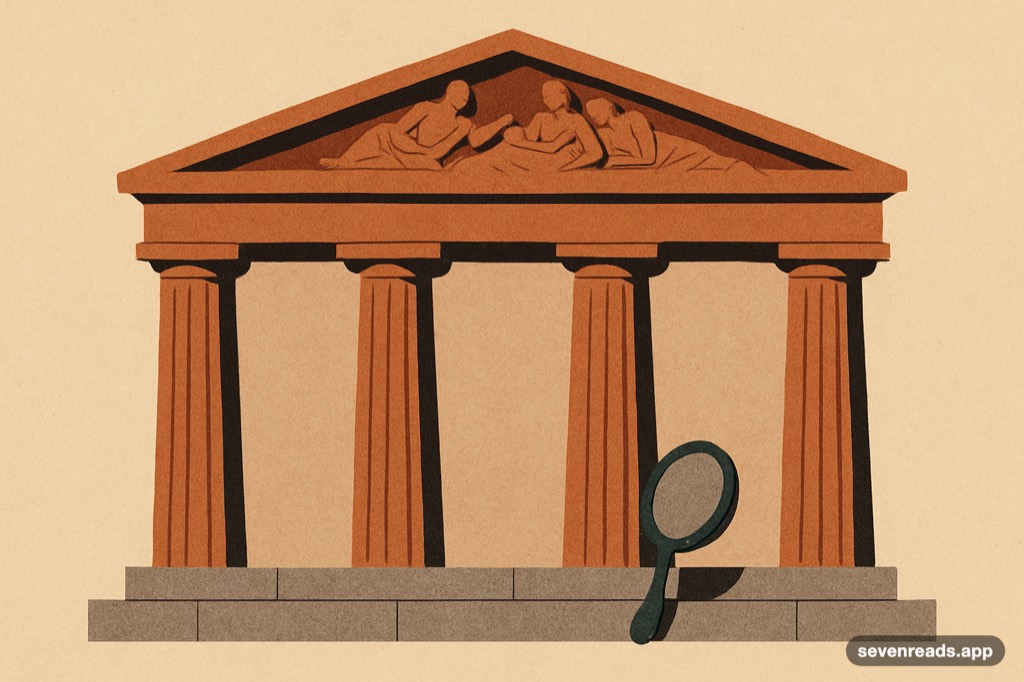
"Know thyself" was carved above the entrance to Apollo's temple at Delphi — and it wasn't an invitation to journal. To the Greeks it meant something closer to a warning: know what you are (mortal, limited, not a god) before you act. Socrates then turned the inscription into a method, and the phrase spent the next two millennia migrating from "know your place" to "examine your life" to the wellness slogan it is now. The original is sharper than every later version.
Here's what it meant, how it changed, and where to read the arguments that made it famous.
Socrates is free in Seven Reads — start reading today.
Get Seven ReadsAt Delphi: a warning at the door
Pilgrims came to Delphi to ask the oracle about the future. The inscription met them at the threshold with a precondition: before you ask what will happen, remember what you are. Beside it stood a second maxim, "nothing in excess" — the pair together are a theory of disaster. The Greeks watched overreach destroy people the way we watch leverage destroy them, and they had a word for the pattern: hubris, the self-forgetting that comes just before the fall. Know thyself, at the door of the god's house, meant: you are not him.
Socrates: the warning becomes a method
Socrates took the inscription personally and professionally. Told the oracle had called him the wisest of men, he set out to disprove it by interviewing Athens' experts — and found that they knew their crafts but not themselves, confidently wrong about justice, courage and virtue. His conclusion: his one advantage was knowing what he didn't know. Self-knowledge, in his hands, became an activity — relentless cross-examination of your own beliefs — and his slogan for its absence is the most quoted line in philosophy: the unexamined life is not worth living. The place to watch him say it is the Apology, his defense at the trial that killed him, and the Symposium, where the method turns on love itself.
What it never meant
Not introspection for its own sake, not personality frameworks, not authenticity-as-brand. The Delphic and Socratic versions are both fundamentally about limits: what you are (mortal), what you actually know (less than you think), what is yours to control (very little — the Stoics' inheritance from the same maxim, drilled nightly in Meditations). Modern self-knowledge tends to mean discovering how special you are; the classical kind meant discovering, precisely, how you aren't. That inversion is why the original still cuts.
Where to read it
Start with the Apology — 90 minutes, Socrates live, the phrase's whole meaning enacted rather than explained. Then the Symposium for the method at its most charming, and Meditations for the Roman version: an emperor using self-knowledge as nightly maintenance. All three are on the shelf, and all three read better with someone to ask when an argument turns slippery.
Frequently asked questions
Where does the phrase know thyself come from?
It was inscribed at the temple of Apollo at Delphi, alongside "nothing in excess." Ancient writers attribute it variously to the Seven Sages; Socrates made it the center of his philosophy.
What did know thyself originally mean?
Closer to "know your limits" than "explore your feelings" — know that you are mortal and not a god before you act. Socrates sharpened it into examining what you actually know versus what you assume.
What book should I read to understand know thyself?
Plato's Apology — Socrates defending the examined life at his own trial, in about 90 minutes. The Symposium and Marcus Aurelius's Meditations extend the idea in opposite directions.
The examined life, ninety minutes in.
Plato and Marcus Aurelius are free in Seven Reads — start reading today.
Get Seven Reads