Kairos Meaning: The Right Moment, as the Greeks Saw It
Greek has two words for time, and the difference is a whole philosophy. Chronos is time as quantity — the clock's tick, the calendar's grind, duration you can measure. Kairos is time as quality: the right moment, the opening, the instant when action lands. Chronos asks "how long?"; kairos asks "when exactly?" — and the Greek insight is that these are different questions with different masters. You manage chronos. Kairos you can only recognize and take.
Here's where the word comes from, how three traditions used it, and what it actually takes to develop a sense for it.
The Greek originals are free in Seven Reads — start reading today.
Get Seven ReadsAn archer's word
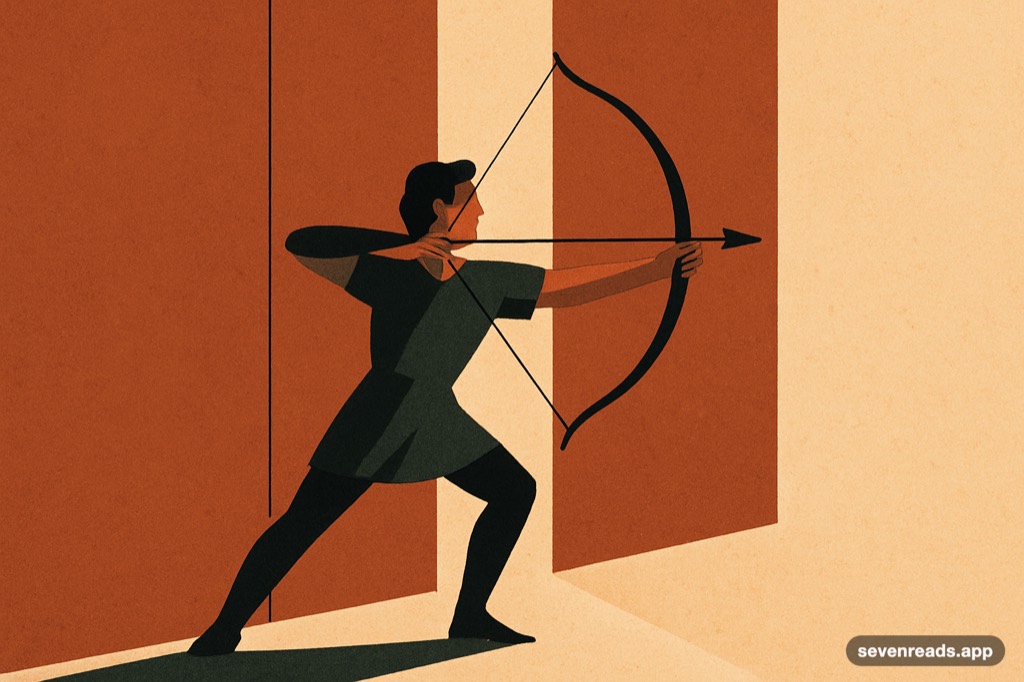
Kairos began as a technical term: in archery, the opening through which an arrow must pass; in weaving, the split-second when the shuttle can shoot through parted threads. Both images carry the full idea — a gap that exists briefly, demands precision, and closes whether or not you acted. The personified god Kairos was sculpted with a long forelock and a bald skull behind: you can seize the moment as it approaches, but there is nothing to grab once it has passed. Ancient viewers didn't need the statue explained.
Rhetoric's version: the timely word
For the Greek rhetoricians, kairos was half the art. The same argument, the same words, land or die depending on the moment — the audience's mood, the news of the day, what was said just before. The sophists taught kairos as improvisation's core skill: knowing which of your prepared things this moment can receive. It's the dimension of persuasion that ethos, pathos and logos don't cover — not who speaks, what's felt, or what's argued, but when. Every comedian who has ever bombed with good material on the wrong night has the concept, whatever they call it.
Theology's version: the appointed time
The New Testament writers, working in Greek, used kairos for time charged with significance — "the kairos is fulfilled," Mark's Jesus announces, meaning not that minutes have elapsed but that the moment has arrived. Paul's letters distinguish the two times constantly: chronos passes; kairos summons. Modern theologians revived the word for historical moments of crisis and demand. The inheritance in secular speech survives in phrases like "a moment of reckoning" — time that asks something of you, as against time that merely elapses.
Developing the sense
Kairos looks like magic from outside and pattern-recognition from inside. The Stoics offer the practical hint: Marcus Aurelius's discipline of attention — being fully where you are — is the precondition, since openings are only visible to those watching the present rather than rehearsing the future. The word's real gift is diagnostic: when something failed, it lets you ask the precise question. Wrong argument — or wrong moment?
Frequently asked questions
What is the difference between kairos and chronos?
Chronos is quantitative time — duration, the clock. Kairos is qualitative time — the opportune moment when action lands. You measure chronos; you recognize and seize kairos.
What does kairos mean in rhetoric?
Timeliness — the dimension of persuasion beyond speaker, emotion and argument: whether this moment can receive these words. The sophists taught it as the core skill of improvisation.
What does kairos mean in the Bible?
Time charged with significance — "the appointed time." Mark's "the kairos is fulfilled" means the decisive moment has arrived, not that a duration has elapsed; Paul contrasts it with mere chronos throughout.
Learn to see the opening.
The rhetoricians and the Stoics are free in Seven Reads — start reading today.
Get Seven Reads