Gulliver's Travels AI: a reading companion that never spoils it
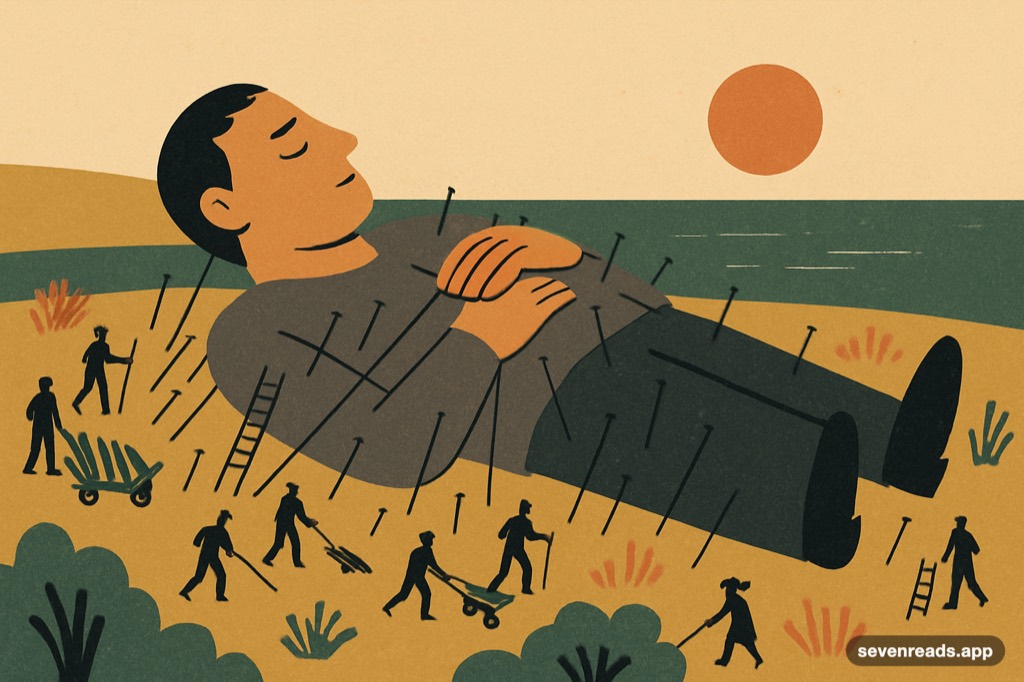
Reading Gulliver's Travels with an AI companion means you can ask questions about the book — by typing or by voice — and get answers grounded in the pages you've actually read, never the ones ahead. Childhood kept the first voyage and dropped the other three — which is roughly like keeping an opening joke and dropping the argument. The complete book is the most savage satire in English, ending in a voyage so misanthropic that readers still argue whether Swift meant it. The little people were the warm-up.
Gulliver's Travels is free in Seven Reads — start reading today.
Get Seven ReadsWhat readers actually ask about Gulliver's Travels
These are the kinds of questions a companion earns its keep on — asked mid-page, answered from the text you've read, without judgment and without leaks:
“What is Swift actually satirizing in this chapter?”
The book's constant question, and period-specific: Lilliputian heel-heights and egg-wars encode real party and church politics of 1720s England; the floating island's scientists parody the Royal Society, project by project. This is prime companion territory — the satire sharpens enormously when the targets have names.
“Is Gulliver supposed to be reliable?”
He's the satire's second edge: a proud, literal-minded reporter whose admiration frequently lands on the wrong thing — his defense of gunpowder to one king is the book's most damning self-portrait of Europe. Watch what Gulliver praises; Swift usually stands directly behind it with a knife.
“Is the fourth voyage misanthropy or medicine?”
The oldest Swift debate: whether the final voyage's verdict on humanity is the author's own or one more position ironized — Gulliver's post-voyage behavior at home is the key evidence, and readers split on what it proves. Reach it unspoiled, then have this argument with the companion in earnest; it's one of literature's best.
The spoiler problem with Gulliver's Travels
The voyages escalate by concealed design — each new land inverts the last, and the fourth (horses, and what serves them) is constructed to arrive as a shock that reframes the whole journey, including what returning home does to Gulliver. Most summaries lead with exactly the reveals Swift saved for last. A general chatbot has read the whole book and will eventually let that knowledge shape an answer. Seven Reads' companion is position-aware: it retrieves only from text before your bookmark, so it cannot reveal what you haven't reached — ask about the ending early and it declines, and tells you where you are instead.
How to read Gulliver's Travels with Seven Reads
Add the book from the built-in store — it's one of 50,000+ public-domain classics included free — and just start reading. Highlight what strikes you, add notes when the thought arrives, and ask the companion anything the moment you wonder. When you finish, Seven writes two things: the book's overview, and a synthesis of what you noticed, built from your own notes and questions. If it's your first classic in a while, our guide to starting the classics pairs well with this book.
Frequently asked questions
Can I read Gulliver's Travels for free?
Yes. Gulliver's Travels is in the public domain, and a well-formatted copy is included free in Seven Reads — one tap adds it to your library, where it reads like any other book, with your position, highlights and notes kept.
Can AI discuss Gulliver's Travels without spoiling it?
Only if the AI is position-aware. Seven Reads tracks exactly where you are in Gulliver's Travels and answers only from the pages behind your bookmark — everything ahead is structurally excluded, so asking about the ending gets a refusal, not a leak. Each voyage's premise is a reveal, and the fourth's design — and its effect on Gulliver — is the book's endgame.
How long does it take to read Gulliver's Travels?
Around 7 hours for most readers. At twenty minutes a day, that's roughly 3 weeks — and a streak matters more than any single sitting.
More classics to read with AI
- All 77 classics you can read with AI — the full list
- Candide AI — Voltaire
- Don Quixote AI — Miguel de Cervantes
- Robinson Crusoe AI — Daniel Defoe
- How the no-spoilers guarantee works