Catch-22 Meaning: The Trap Where the Rules Eat Themselves
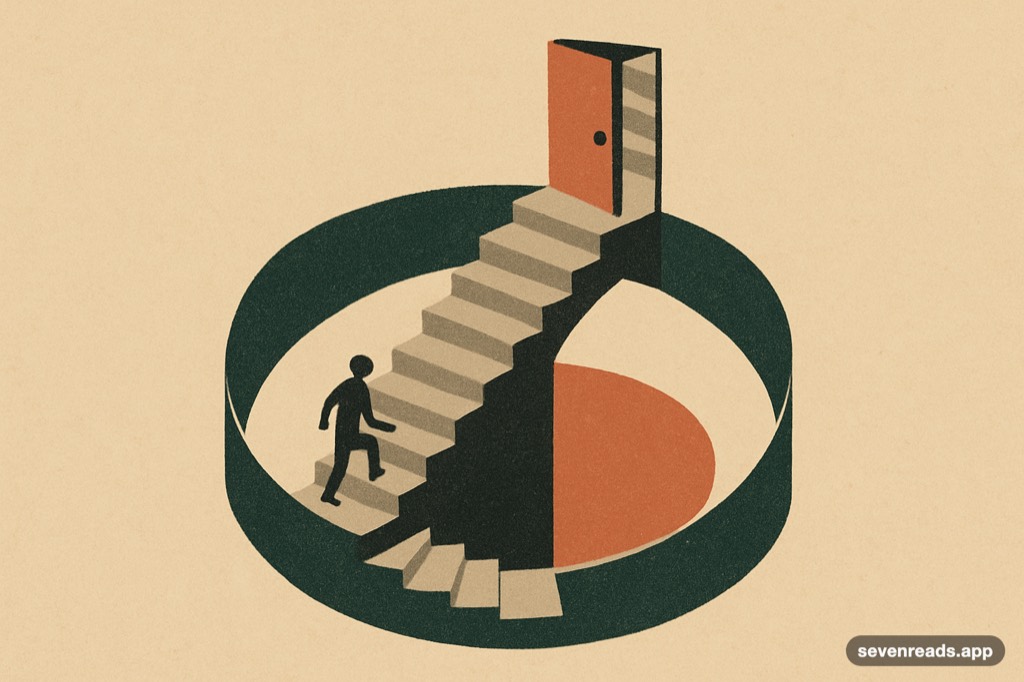
A catch-22 is a trap built out of rules: a situation you can only escape by meeting a condition the situation itself makes impossible. You can't get the job without experience, and can't get experience without the job. The name comes from Joseph Heller's 1961 novel, where the catch is spelled out with bureaucratic perfection: a bomber pilot can be grounded for insanity — but asking to be grounded proves he's sane, because wanting to avoid death is what sane men do. "That's some catch, that Catch-22," Yossarian observes. "It's the best there is," the doctor agrees.
Here's the exact logic, what does and doesn't qualify, and the phrase's older philosophical family.
The absurdity's ancestors are free in Seven Reads — start reading today.
Get Seven ReadsThe mechanism, precisely
What makes a true catch-22 isn't circularity alone — it's that the escape condition is consumed by the attempt to use it. In Heller's version: the exemption exists (insanity grounds you), the trigger exists (you may ask), and the act of triggering it destroys your eligibility. That's sharper than a dilemma (two bad options) or a vicious circle (A worsens B worsens A). A catch-22 is a rule system that is formally complete and practically escape-proof — and, crucially, someone benefits from it being so. Heller's deeper joke is that the catch may not even be written down anywhere: late in the novel, the men conclude the catch's real content is "they have a right to do anything we can't stop them from doing."
What actually qualifies
No credit without credit history. No apartment without local references; no local references without an apartment. Needing a password reset sent to the email you're locked out of. What doesn't qualify: mere hard choices ("damned if you do, damned if you don't" is usually just a dilemma), or chicken-and-egg problems that time can solve. The test: write the rule down and check whether invoking the exception voids the exception. If yes, you've found one — and Heller's advice, dramatized across the whole novel, is that such systems are not argued with from inside. Yossarian's answer is exit.
The older family
The logic is ancient even though the name is from 1961. The liar's paradox ("this sentence is false") is a catch-22 built from one sentence. The quixotic tradition runs on a cousin: Don Quixote can't be cured of his madness by evidence, because the madness includes an explanation for all evidence (enchanters). And Kafka got closest before Heller — the Court in The Trial requires Josef K. to defend himself against a charge it will not name, a catch so pure Heller acknowledged the debt. What Heller added was tone: the discovery that the airtight trap is, among other things, funny, which may be the sanest available response.
Reading the novel behind the phrase
People who know only the idiom expect a war story; the book is closer to a logic puzzle staged as farce, with the horror arriving late and all at once. Its structure imitates its subject — the chronology loops, events recur with more detail each pass, and the missing center (what happened to Snowden) is withheld the way the catch itself is. It's still in copyright, so it's not on the free shelf — but its ancestors, Cervantes and Kafka, are.
Frequently asked questions
What does catch-22 mean in simple terms?
A rule-trap where the only escape requires something the trap itself makes impossible — like needing experience to get the job that would give you experience. Invoking the exception cancels the exception.
Where does the term catch-22 come from?
Joseph Heller's 1961 novel: pilots can be grounded for insanity, but requesting grounding proves sanity. Heller originally titled it Catch-18; the number changed to avoid clashing with another book.
What is the difference between a catch-22 and a dilemma?
A dilemma is two bad options; a catch-22 is a closed loop where the exit condition consumes itself. You can choose your way through a dilemma — a catch-22 has to be escaped from outside the rules.
The trap, and its ancestors.
Cervantes and Kafka — the catch's grandfathers — are free in Seven Reads — start reading today.
Get Seven Reads