Allegory of the Cave Meaning: Plato's Story, Explained
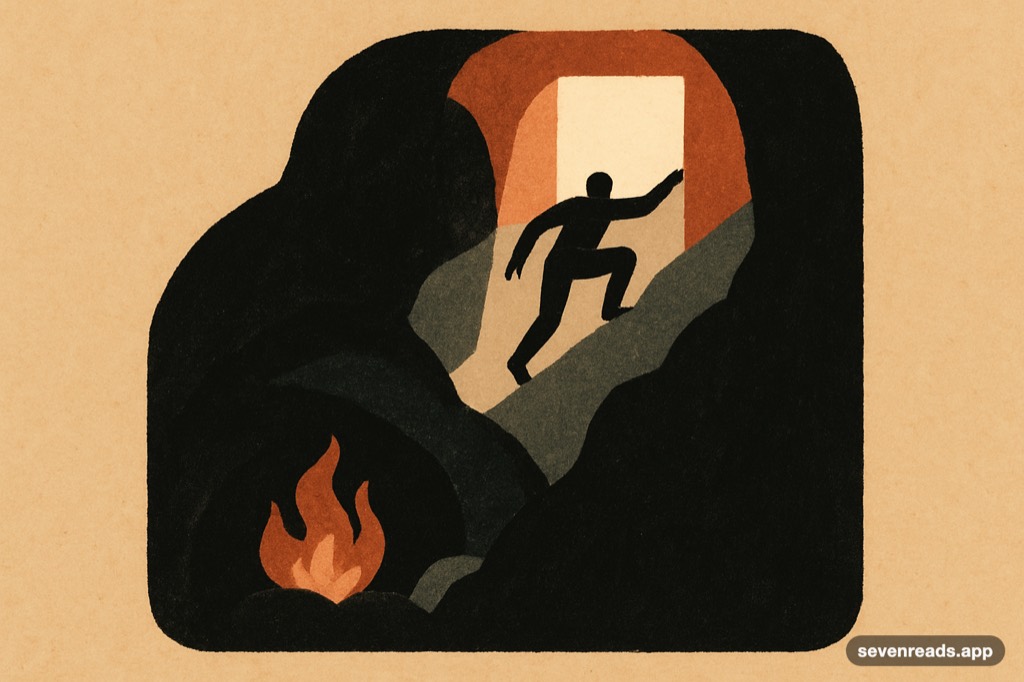
The allegory of the cave is Plato's picture of the human condition and its cure: we begin as prisoners taking shadows for reality, education is the painful turnaround toward what actually is, and — the part posters omit — whoever escapes is obligated to go back down. It appears in Book VII of the Republic, and it's not a standalone image about illusion; it's the keystone of an argument about what education is and what knowers owe everyone else.
Here's the allegory as Plato actually built it — setup, ascent, return — and what each stage is doing.
Read the cave in its actual context — the Republic is free in Seven Reads — start reading today.
Get Seven ReadsThe setup: prisoners, fire, shadows
Prisoners are chained in a cave from childhood, facing a wall. Behind them burns a fire, and between fire and prisoners runs a walkway where objects are carried; the prisoners see only the objects' shadows and hear echoes — so shadows and echoes are, for them, simply what "real" means. Plato's first move is the uncomfortable one: asked who the prisoners are, Socrates answers that they're like us. The cave isn't someone else's ignorance; it's the default setting.
The ascent: education as suffering
A prisoner is freed — and everything about the liberation hurts: the fire blinds, the climb is steep, and the sunlit world outside is initially unbearable to look at. He adjusts in stages — shadows first, then reflections, then things, finally the sun itself. The stages matter: Plato is describing education as a reorientation of the whole person, not a download of facts, and insisting that real learning always passes through a phase where the learner is worse off — dazzled, disoriented, missing the old certainties. Anyone who has had a worldview dismantled recognizes the sequence.
The return: the forgotten third act
Then the freed prisoner is made to go back down — where the dark blinds him as badly as the light did, the prisoners find him ridiculous, and, Socrates adds dryly, they'd kill the liberator if they could (his audience knew that wasn't hypothetical — Athens had executed Socrates). This is the stage that transforms the allegory's meaning: enlightenment isn't escape but a round trip, and the philosopher's obligation to return is precisely the argument for philosopher-rulers the surrounding chapters are making. An interpretation of the cave that stops at the sunshine has read two-thirds of it.
What it means — and what it doesn't
Fairly drawn: most of what passes for reality is secondhand images; genuinely learning anything reorients painfully; and knowledge creates obligation. Less fairly drawn: the smug reading, in which the interpreter is naturally the escaped one and everyone else is chained — the text blocks this by making the escapee blind, laughable and endangered on return. The cave describes a condition everyone shares and an ascent anyone begins by noticing their shadows are shadows — which is why the allegory belongs in the Republic's education argument rather than on a dorm poster, and why it repays reading in place, from the source, ideally with something to argue against.
Frequently asked questions
What is the allegory of the cave in simple terms?
People chained in a cave mistake shadows for reality; one escapes, painfully adjusts to the real world, and returns to free the others — who mock him. It's Plato's picture of ignorance, education as painful reorientation, and the knower's duty to return.
What do the shadows represent?
Secondhand reality: appearances, received opinions, images of things rather than things — everything taken as true because it's all that's ever been shown. In Plato's larger system, the visible world itself stands to the forms as shadows stand to objects.
Why does the freed prisoner go back into the cave?
Because Plato's argument requires it: education creates obligation, and the Republic is building the case that those who see must govern. The return — with its blindness and mockery — is the allegory's actual conclusion, and the most often omitted part.
Read all three acts in place.
The Republic is free in Seven Reads — start reading today.
Get Seven Reads