AI Reading Apps vs. E-Readers: What's Actually Different
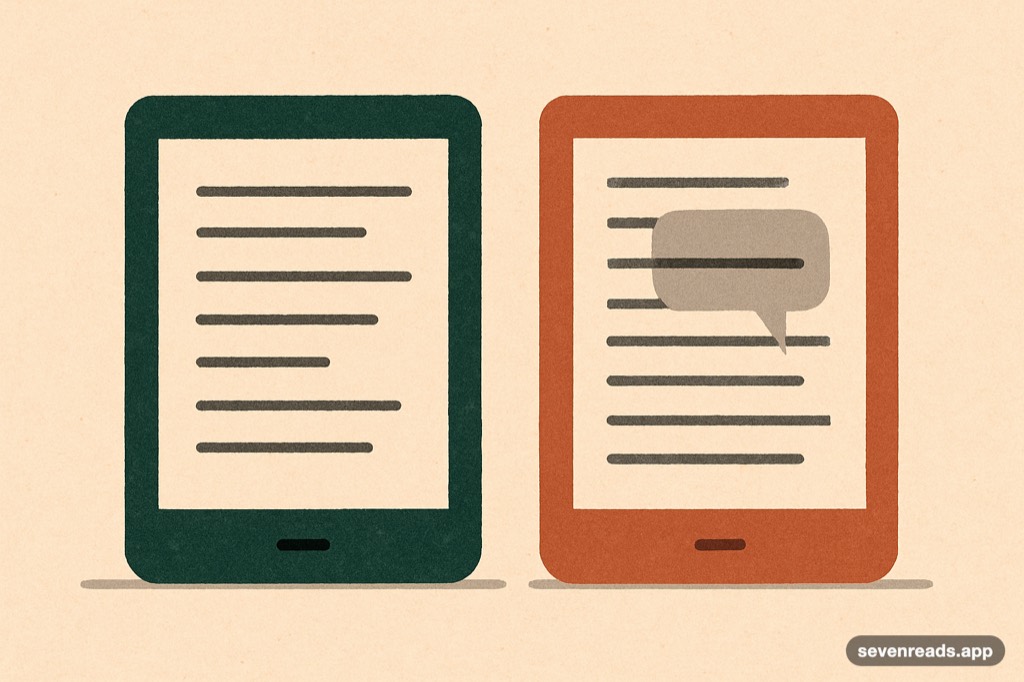
The difference between an e-reader and an AI reading app is the difference between a bookshelf and a book club: one stores and displays the text beautifully, the other can also discuss it. Concretely, an AI reading app adds four capabilities no plain e-reader has — grounded questions, spoiler-safe recaps, synthesis of your notes, and conversation by voice — while keeping everything e-readers already do well.
Here's the honest comparison, including the cases where the plain e-reader is still the right call.
Seven Reads is the second column — reader, companion, notes and streaks in one.
Get Seven ReadsWhat e-readers already solved
Credit first: modern e-readers nailed the reading surface — typography, annotation, sync, libraries. If your reading never generates questions (or you prefer carrying them unanswered, a legitimate taste), the surface is the whole product and a dedicated e-ink device with weeks of battery is hard to argue with. The AI app's case rests entirely on what happens when reading produces questions — which, for difficult or long books, is constantly.
The four real differences
Questions on the page: select a passage, ask, get an answer grounded in your book's text — the capability everything else builds on (what chatting with a book means). Spoiler-safe recaps: "remind me where I am" after two weeks away, generated only from pages behind your bookmark — the feature that rescues abandoned books. Synthesis: your highlights, notes and questions compiled into a record of what you took from the book — memory infrastructure, not just storage. Voice: the same conversation, hands free. None of these retrofit onto a plain e-reader, because all four require the app to hold the text, your position and a grounded model together.
The differences that are marketing
Some claimed distinctions don't survive inspection: "AI-powered recommendations" (storefront feature, not reading feature), "smart highlights" that just color passages statistically, summaries of books you haven't opened (that's a summary app wearing reader clothes). The test for any AI feature: does it operate on your reading of this book at your position? If not, it's a bolt-on.
Choosing honestly
Plain e-reader: beach novels, battery-critical travel, readers who never want to ask. AI reading app: the classics, difficult nonfiction, long books with big casts, students, and anyone whose abandoned-book shelf is really an unanswered-question shelf. Many readers run both — e-ink for the fiction that flows, the companion app for the books that fight back.
Frequently asked questions
What does an AI reading app do that a Kindle doesn't?
Four things: answer questions grounded in your book's actual text, generate spoiler-safe recaps from your exact position, synthesize your notes and questions into a record of the book, and hold that conversation by voice. E-readers display and annotate; AI reading apps can also discuss.
Do AI reading apps work with my own books?
Generally yes for EPUBs and text-based PDFs — the AI capabilities work identically on uploaded books, since answers come from the indexed text rather than the model having heard of the title. Seven Reads also includes 50,000+ public-domain classics.
Is an e-ink e-reader still worth it?
For long-battery, eye-comfort reading of books that don't generate questions — absolutely. The AI app earns its place on the books that do: difficult, long, or heavily populated ones where questions, recaps and synthesis change whether you finish.
Try the book-club column.
Seven Reads pairs a serious reader with a grounded companion — questions, recaps, synthesis and voice, on 50,000+ free classics and your own books.
Get Seven Reads