Zeitgeist Meaning: The Spirit of the Age, Explained
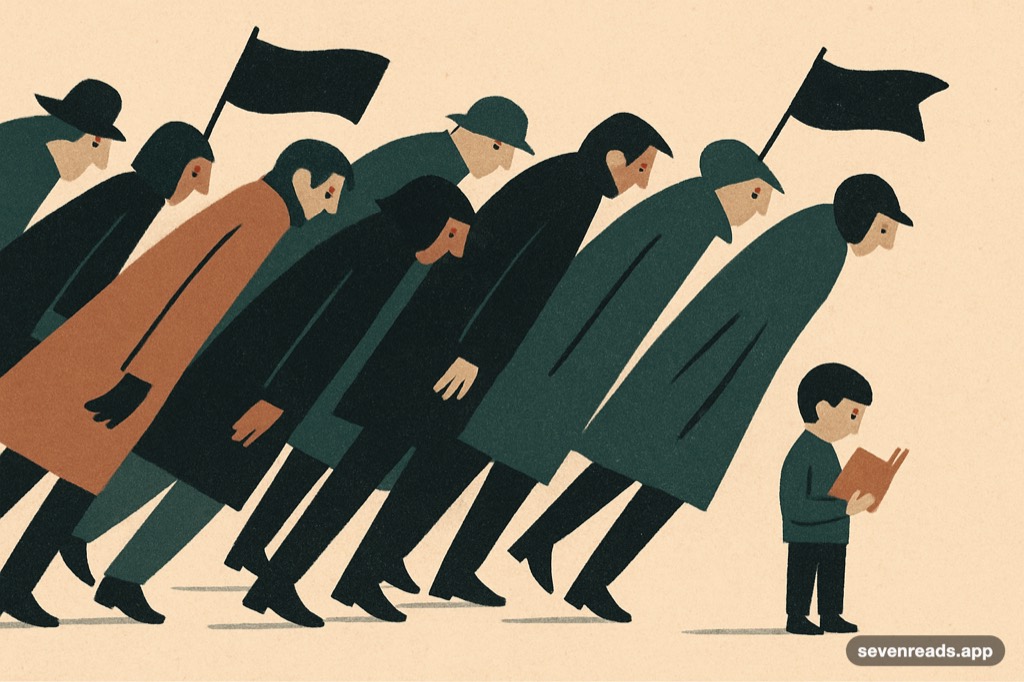
Zeitgeist is German — Zeit (time) + Geist (spirit, mind) — and it names something everyone senses and no one can point to: the characteristic mood, assumptions, and taste of an era, the invisible weather a whole generation thinks inside. The word carries real philosophy in its luggage: it grew up around Herder and Hegel, for whom the spirit of an age wasn't a metaphor but close to the engine of history itself.
Here's where the idea comes from, what it actually claims, and how to use the word without hand-waving.
The era-defining originals are free in Seven Reads — start reading today.
Get Seven ReadsFrom Herder to Hegel
Johann Gottfried Herder attacked eighteenth-century critics for judging every culture by timeless rules; each age, he argued, has its own inner character that must be understood from inside — he used Geist der Zeiten, spirit of the times. Hegel built the skyscraper: history, in his system, is Spirit (Geist) progressively coming to know itself, and each era's philosophy, art, law and religion are one stage of that self-discovery wearing four costumes. His famous line puts it exactly: "philosophy is its own time comprehended in thought." On this view you can no more think outside your zeitgeist than see your own eyes — even the rebels of an age, Hegel noted, rebel in its characteristic style.
What the claim really is
Stripped of metaphysics, the zeitgeist thesis says: contemporaries share a mostly invisible set of assumptions — about what's obvious, what's shameful, what's worth wanting — and those assumptions, not just events, are what make 1848 or 1968 or 2020 feel like one thing happening everywhere at once. The strong evidence is simultaneous invention: calculus (Newton and Leibniz), evolution (Darwin and Wallace), the same novel-forms appearing in different countries the same decade. Ideas seem to ripen in the water supply. The weak point is circularity — the zeitgeist explains what people did, and what people did is our only evidence for the zeitgeist. It's a description that moonlights as a cause.
Reading old books is zeitgeist-vision
The one reliable way to see a zeitgeist is from outside — which mostly means from another century. Reading Frankenstein, you can watch 1818's assumptions about science and responsibility stand out like furniture its author couldn't see; reading Nietzsche, you meet a man deliberately writing against his age — his term unzeitgemäß, "untimely," is the zeitgeist concept used as a weapon. And the uncomfortable corollary: our own era's blind spots are exactly as visible to the future as the Victorians' are to us. Old books are the only mirror that shows the back of your head.
Using the word honestly
"It captured the zeitgeist" is criticism's laziest sentence when it means only "it was popular." The word earns its keep when it names the assumption underneath the popularity — not that everyone watched the same show, but what everyone apparently agreed to be anxious about. Name the shared assumption and you're doing Herder's work; skip it and you're just saying "vibes" in German.
Frequently asked questions
What does zeitgeist literally mean?
German for "spirit of the time" — Zeit (time) + Geist (spirit/mind). It names the shared mood, taste and assumptions that characterize an era.
What did Hegel mean by zeitgeist?
For Hegel, each era's art, philosophy, law and religion express one underlying stage of Spirit's development — "philosophy is its own time comprehended in thought." You can't think outside your age; even rebellion happens in the age's style.
How do you use zeitgeist in a sentence properly?
Name the shared assumption, not just the popularity: "the film caught the zeitgeist's suspicion that institutions were lying" works; "it captured the zeitgeist" alone is just German for "it was trendy."
See your own era from outside.
The books that defined their ages are free in Seven Reads — start reading today.
Get Seven Reads