What AI Still Gets Wrong About Books
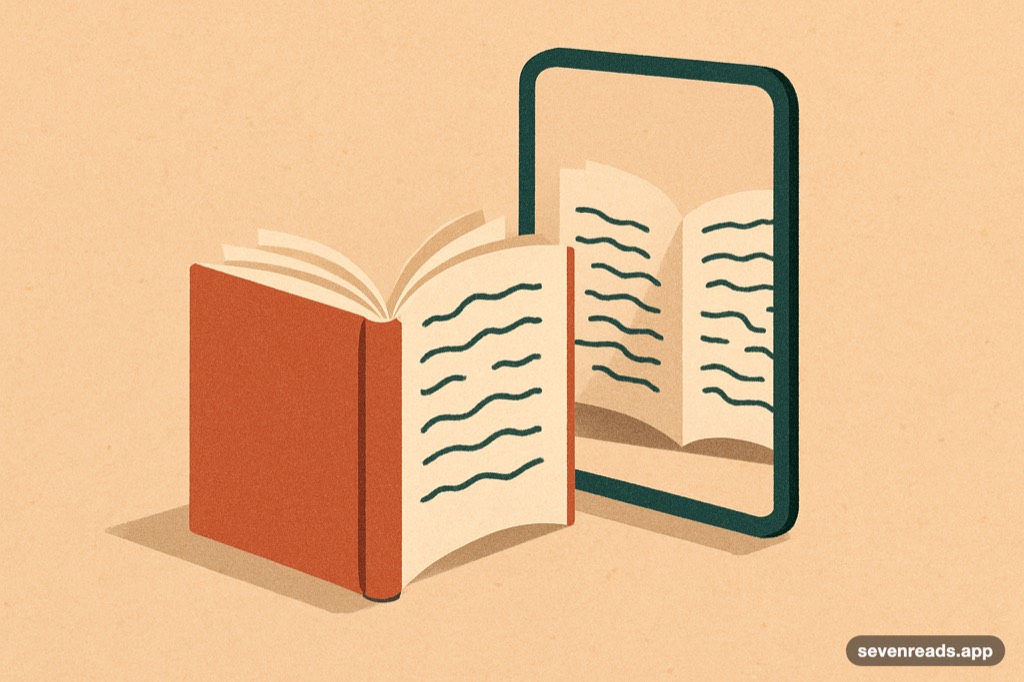
AI gets books wrong in five reliable ways: it invents quotations, merges editions and adaptations into one remembered blur, leaks endings while trying not to, defaults to generic literature-class readings, and delivers all of it with unearned confidence. Knowing the failure modes is half the defense; knowing which are fixed by architecture — and which only by your own judgment — is the other half.
We build AI reading software, so this is partly a list of our own homework. Here's each failure, why it happens, and what actually fixes it.
Grounded retrieval fixes four of the five — it's the architecture Seven Reads runs.
Get Seven ReadsInvented quotes and merged details
Ask a general model for a line from a novel and you'll often get something book-flavored: right voice, wrong words — or a film adaptation's line wearing the novel's citation. The cause is architectural: the model holds a compression of many texts about the book, not the book. The fix is retrieval — answering from the actual pages makes quotes checkable and editions singular. Any tool discussing a specific book without its text in hand is reciting from a blur.
The ending leak
Told "don't spoil past chapter 4," a model must reconstruct chapter-4 knowledge by inference from whole-book memory — and inference fails invisibly: emphasis shaped by later events, characters weighted by their endings. This one has no prompt-level fix; only a structural boundary — retrieval physically limited to your position — makes the leak impossible. It's the failure mode our whole product thesis hangs on.
The generic reading
Ask what a book "means" and general models converge on the same safe essay: themes of identity, critique of society, ambiguity as richness. It's not wrong; it's uninformative — the mean of every study guide ever written. The fix here is only partly architectural: grounding helps (a companion citing your pages must engage specifics), but the rest is prompting craft — pressure questions ("weakest claim," "strongest objection," "what would X say") force positions where "analyze this" invites mush.
False confidence, and what stays your job
All the above arrives fluent and sure — the register of expertise without its accountability. Grounding fixes confidence about the text (claims come with receipts); nothing fixes confidence about interpretation, because interpretive judgment isn't a fact to retrieve. The stable division of labor: trust a grounded companion on what the book says, treat what the book means as an argument between you — and treat any tool that blurs that line, in either direction, as unfinished.
Frequently asked questions
Why does AI make up quotes from books?
General models store a compression of everything written about a book — editions, summaries, adaptations, discussions — not the text itself, so "quotes" are reconstructions in the book's style. Retrieval-grounded tools fix this by answering from the actual pages, making every quote checkable.
Can AI hallucinations about books be fixed?
Four of the five main failures — fake quotes, merged editions, ending leaks, ungrounded claims — are fixed by architecture: retrieval from the real text plus a hard position boundary. The fifth, generic interpretation, is only partly fixable; pressure questions and your own judgment do the rest.
How do I know if an AI reading tool is grounded?
Two tests: ask for a quote you can verify against your copy (grounded tools quote exactly), and ask how the book ends mid-read (grounded, bounded tools refuse). Passing both means answers come from your pages; failing either means memory is in the loop.
Use the architecture that does the homework.
Seven Reads quotes your edition exactly, stops at your bookmark, and saves its confidence for what it can cite. The interpretation stays yours.
Get Seven Reads