Utopia Meaning: The Pun Hidden in the Word
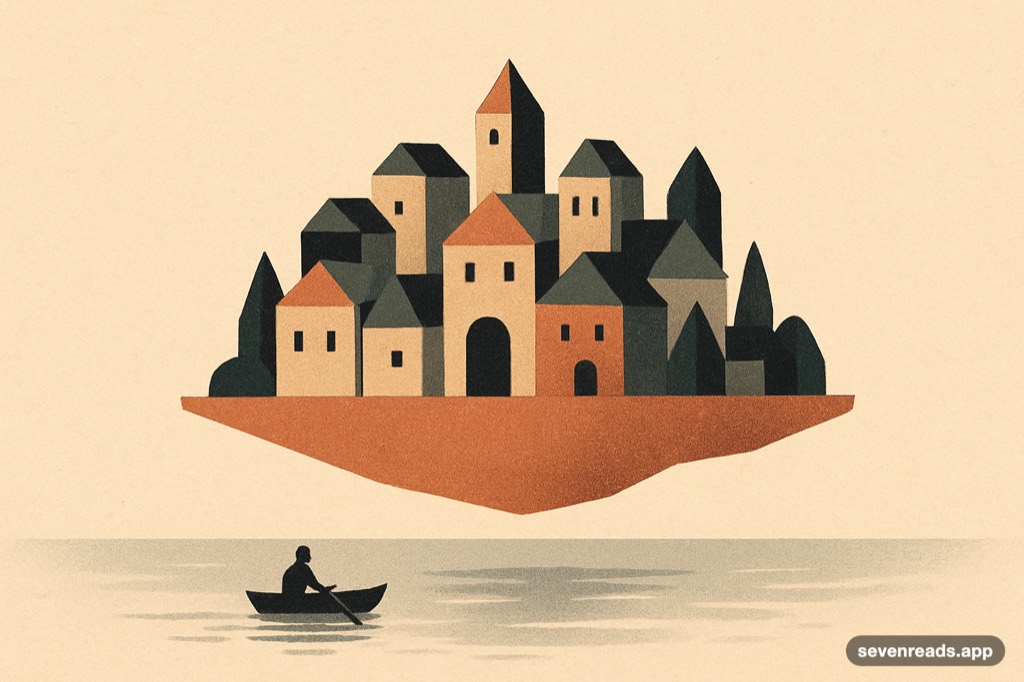
Utopia does not mean "perfect place." It means no place — Greek ou (not) + topos (place) — and Thomas More, who coined it in 1516, chose the word as a bilingual joke: spoken aloud in English it sounds identical to eu-topia, "good place." The pun is the meaning: a society so good it exists nowhere. Five centuries of arguments about whether utopias are inspiring or dangerous are, in a sense, arguments about which half of More's pun to hear.
Here's the word's story, what More's original book actually says, and how "utopian" became both a compliment and an insult.
Utopia is free in Seven Reads — start reading today.
Get Seven ReadsThe book that coined it
More's Utopia (1516) is a traveler's report of an island commonwealth: no private property, six-hour workdays, religious tolerance, communal meals — and also slavery, rigid surveillance of movement, and colonial war when the island wants land. That double edge is deliberate. More was a Catholic lawyer who would die for conscience under Henry VIII, and his narrator is named Hythloday — Greek for "peddler of nonsense." Whether the book is a blueprint, a satire, or a thought experiment designed to make readers argue is exactly what readers have argued ever since. The joke in the title suggests More knew.
How the word split in two
By the nineteenth century "utopian" had become an insult in serious politics — Marx and Engels dismissed rivals as "utopian socialists," meaning dreamers without a mechanism. At the same time the utopian novel boomed: Bellamy's Looking Backward (1888) was one of the century's best sellers and spawned real political clubs. The word now carries both loads at once — "utopian" praises the ambition and mocks the naivety in the same breath — which is why careful writers say "utopian project" for the dream and reach for dystopia when the dream turns carnivorous.
The deeper lineage
More was answering Plato. The Republic's city built in speech — philosopher rulers, property abolished for the guardian class, education engineered from birth — is the template every literary utopia works from or against, and Plato too left readers unsure how literally to take it. The pattern runs: a designed society, a visitor or student being shown around, and the nagging question of what the design costs. Utopian writing is less a genre of answers than a machine for exposing what a society thinks perfection would cost — read Utopia beside the Republic and the machine is already fully assembled by 1516.
Why "no place" still matters
The literal meaning does real work. A utopia that admits it is "no place" is a measuring stick — somewhere to stand while judging the actual world. A utopia that forgets, and mistakes itself for an address, is where the twentieth century's disasters came from; every great dystopia is a utopia that got confident. More's pun holds the humility in the word itself: the good place, and no place, in one breath.
Frequently asked questions
What does utopia literally mean?
"No place" — Greek ou (not) + topos (place). Thomas More coined it in 1516 as a pun on eu-topos, "good place": a society so good it exists nowhere.
Was Thomas More serious about Utopia?
Scholars still argue — the book mixes genuinely radical ideas (no private property, tolerance) with things More clearly opposed, and the narrator's name means "peddler of nonsense." Most readers now take it as a deliberately double-edged thought experiment.
What is the difference between utopia and dystopia?
They're mirror twins: utopia is the imagined good society ("no place"), dystopia the imagined bad one ("bad place"), coined off More's word in the 19th century. Most dystopias are utopias told from the inside.
Five centuries of the argument.
Utopia and The Republic are free in Seven Reads — start reading today.
Get Seven Reads