God Is Dead Meaning: Nietzsche's Most Misread Line
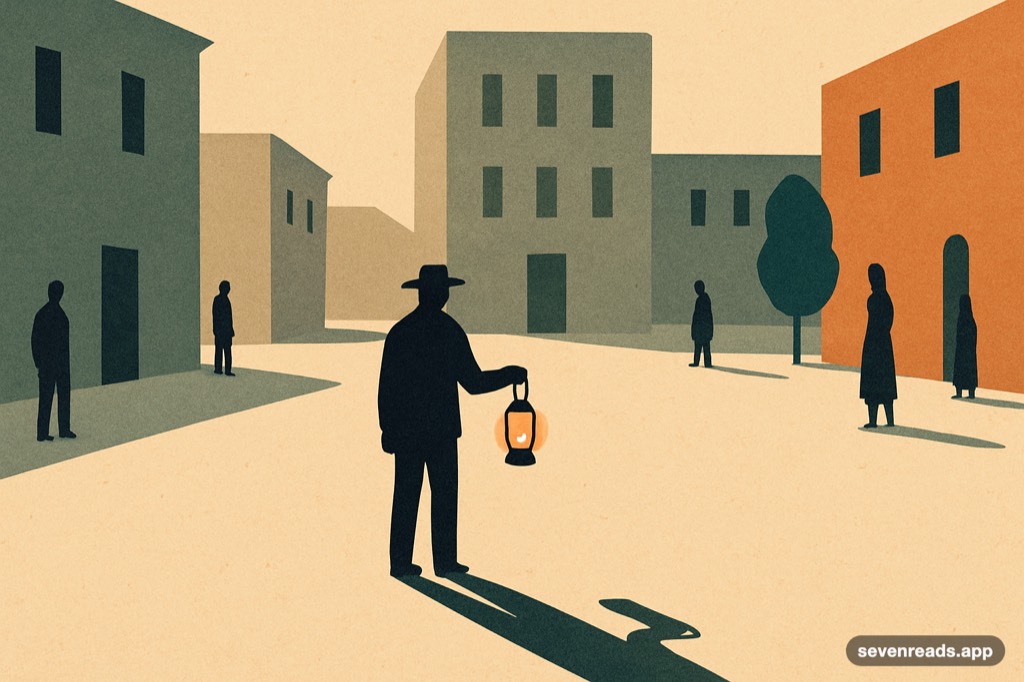
"God is dead" is the most misquoted sentence in philosophy: Nietzsche's line is not triumphant atheism but a diagnosis delivered in mourning dress — European culture, he claims, has already stopped believing in its own foundation, and hasn't yet noticed that everything built on that foundation (its morality, meaning and institutions) is now unsupported. The announcement comes from a madman with a lantern, and the crowd that laughs at him is us: the ones who did the killing and haven't felt the consequences arrive.
Here's the scene as written, what the death actually refers to, and the crisis Nietzsche thought it opened.
The Gay Science is free in Seven Reads — start reading today.
Get Seven ReadsThe scene: a madman, a lantern, a laughing market
The famous formulation appears in The Gay Science as theater: a madman lights a lantern in the morning, runs to the marketplace crying that he seeks God, and is mocked by bystanders — who, Nietzsche specifies, are atheists already. The madman's answer is the accusation: we have killed him, you and I — followed by the vertigo questions (who gave us the sponge to wipe away the horizon? are we not straying through an infinite nothing?) and the crucial closing note: he has come too early; the deed is done but the news hasn't arrived. The staging carries half the meaning — this is a report on a cultural event, delivered to people who caused it and can't yet hear it.
What died, precisely
Not a being — a function. "God" in the sentence names the load-bearing role that Christian belief played in European life: guarantor of morality's authority, of meaning's objectivity, of truth's value, of history's direction. Nietzsche's claim is historical: science, scholarship and honesty (virtues Christianity itself cultivated, he notes with relish) had eroded the belief's credibility until the center no longer held — the "death" happened in the culture's actual confidence, whatever individuals still professed. The genius of the diagnosis is its timing argument: foundations fail decades before the buildings notice.
The crisis, not the celebration
The misreading takes the sentence as victory lap; the text treats it as emergency. If the foundation is gone, everything derived from it — human dignity, equal moral worth, the authority of "thou shalt not" — floats unsupported, and Nietzsche's dread scenario is nihilism: the stage where inherited values persist as habits, then hollow out, then collapse into "nothing matters." His life's work is the response: whether humans can create values with the same binding force the old foundation provided — the project behind the overman and eternal recurrence as a new test of affirmation. One can dispute his answer while granting the diagnosis; many of his best readers do exactly that.
Reading it responsibly
Two disciplines keep the sentence honest. Read it in scene — the mourning, the "too early," the accusation of the already-atheist crowd — because the staging blocks both the triumphalist and the merely anti-religious readings. And read it as a testable claim about secularization's aftermath: whether post-religious cultures can sustain binding values is a live question a century and a half later, which is why the passage still gets argued rather than merely cited. The scene is two pages; read it whole and argue back.
Frequently asked questions
What did Nietzsche mean by saying God is dead?
That European culture's effective belief in God — the foundation under its morality and meaning — had already collapsed, and the consequences hadn't yet been felt. It's a diagnosis of a cultural event, delivered as warning, not a celebration of atheism.
Was Nietzsche happy that God is dead?
The published scene is anything but happy: a madman in mourning, vertigo questions, and dread of the nihilism that follows when inherited values lose their support. Nietzsche saw opportunity in the crisis, but the announcement itself is written as catastrophe.
Who actually announces the death of God in Nietzsche's text?
A madman with a lantern, addressing a mocking marketplace of nonbelievers — and later Zarathustra echoes it. The dramatic staging matters: the news comes "too early," to people who did the deed without grasping it.
Two pages that changed the century.
The Gay Science is free in Seven Reads — start reading today.
Get Seven Reads