Doppelganger Meaning: The Double That Walks Beside You
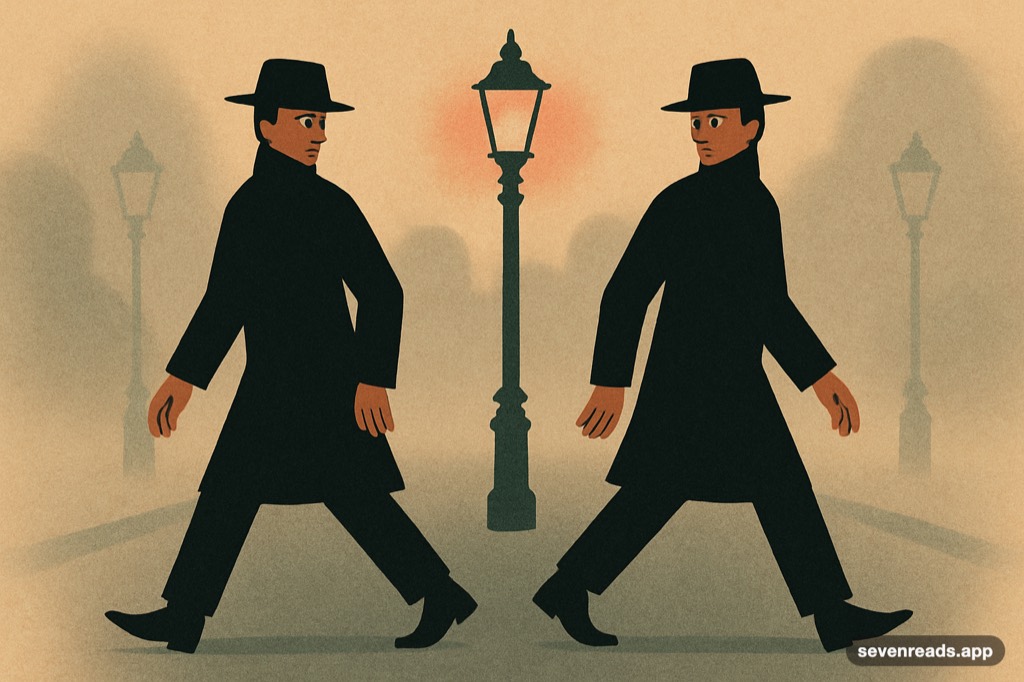
A doppelganger is an uncanny double — someone who looks exactly like you but isn't. German Doppelgänger, "double-goer": the walking duplicate. Modern usage runs light ("I met your doppelganger at the airport"), but the word arrives trailing folklore in which seeing your own double was an omen of death, and a literary tradition — Poe, Stevenson, Dostoevsky — that used the duplicate for something sharper than spookiness: the double as the self you refuse to be, out running errands.
Here's the word's origin, the folklore's rules, and the three classic dopplegänger stories that built the theme.
The double's classics are free in Seven Reads — start reading today.
Get Seven ReadsA young word for an old fear
The German term is surprisingly recent — coined by the novelist Jean Paul in 1796, footnoted as "people who see themselves." The fear is much older: Roman genius doubles, the Norse vardøger (a phantom self that arrives places before you do), British "fetches" whose appearance foretold death. The folklore's consistent rule: others seeing your double is uncanny; you seeing it is terminal. Reports cluster around exhaustion and fever — Lincoln recorded seeing his own doubled reflection, and took it, his wife worse, as an omen. The word's export success (English simply adopted it) suggests every language needed a term for the experience.
The literary double: the self outsourced
Nineteenth-century writers turned the omen into an instrument. Poe's "William Wilson" (1839) sets the template: a dissolute man dogged since childhood by an identical schoolmate — same name, same face, a whisper — who appears precisely at his worst moments; the ending's mirror-logic has been borrowed a hundred times. Dostoevsky's The Double (1846) runs the office-nightmare version: a clerk's duplicate charms everyone the original alienates, and takes his life over by simply being better at being him. And Jekyll and Hyde (1886) is the theme's masterpiece — the double not met but manufactured, the respectable self distilling its appetites into a second body. Three stories, one discovery: the double is always the disowned remainder — conscience (Poe), confidence (Dostoevsky), appetite (Stevenson).
Why the double unsettles
Freud filed the doppelganger under the uncanny — the familiar made strange — and the double is its purest case: nothing is more familiar than your face, so nothing is stranger than meeting it. The deeper disturbance the stories exploit: identity feels singular, and the double is a walking counterexample — if that's me over there, what exactly is here? Which is why the theme revives in every era of identity-anxiety: romantic Germany, the Victorian double life, and the present, where your data-shadow and deepfake are the folklore's newest fetches.
Using the word
Casual use for lookalikes is standard and needs no shiver. The pedantic notes: plural doppelgangers (English) or Doppelgänger (German, unchanged); the umlaut is optional in English. And the literary sense remains available for precision: calling a rival your doppelganger — rather than your nemesis — claims something specific: not the enemy you deserve, but the self you dodged.
Frequently asked questions
What does doppelganger literally mean?
"Double-goer" in German — an apparition or living duplicate of a person. Coined by the novelist Jean Paul in 1796; English borrowed it whole.
Is seeing your doppelganger a bad omen?
In the folklore, yes — traditionally, others seeing your double was uncanny, but seeing it yourself foretold death. Lincoln famously recorded a doubled reflection and read it darkly.
What are the classic doppelganger stories?
Poe's "William Wilson" (the conscience-double), Dostoevsky's The Double (the better-at-your-life double), and Jekyll and Hyde (the manufactured double). Each duplicate embodies what its original disowned.
Meet yourself, unspoiled.
Poe, Dostoevsky and Stevenson are free in Seven Reads — start reading today.
Get Seven Reads